1 Introduction
1.1 Purpose of this chapter
Every time we perform a financial analysis, we do so to support some decision-making process. In this chapter, we will briefly discuss which decisions these are and what type of analysis is probably the most useful. We will also introduce one of our main themes: having to make decisions in the face of significant uncertainty. We believe that this discussion is important because it provides the rationale for nearly all of the analysis steps that we will lay out for you in this course.
1.2 Financial models to assess future performance
Many important decisions made by management teams and investors are based on financial analysis. Prominent examples are investment decisions, such as which markets to enter, whether to acquire another firm, or strategic decisions regarding internal resource allocation. Similarly, lending and investment decisions by banks or equity investors are usually supported by extensive financial analysis and modeling.
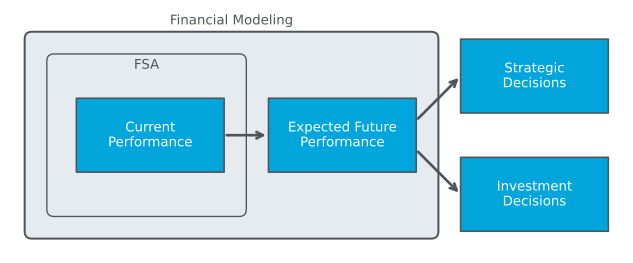
As Figure 1.1 shows, all these decisions have one thing in common. All have as main input the expected future performance of the analysis target. The value of a firm is a function of the expected future profitability. Likewise, resource allocation decisions depend on which alternative is more likely to provide the highest expected future return on investment.
However, future performance is highly uncertain. Markets are complex, the actions of numerous actors (customers, competitors, etc.) need to be anticipated, and economic conditions can quickly change for unforeseen circumstances. Thus, to make sound decisions, decision makers need to carefully assess not only the expected future performance potential of the firm/investment/target but also how uncertain these expectations are. We consider a financial model to be the main tool to build, execute, and communicate these assessments. Figure 1.1 makes one final point: Any assessment of future prospects begins with an in-depth assessment of the current economic situation. Only if we understand the current situation can we extrapolate what future opportunities are available, which future scenarios are more likely than others, etc.
In this course, we focus on analyzes aimed at valuing a firm’s common equity. But the general framework is useful for many of the other decision contexts as well. We divide a typical valuation analysis into three parts: understanding current fundamentals, forecasting future fundamentals, and finally valuing fundamentals (see also., Lundholm and Sloan 2019; Koller et al. 2020). These three parts build the basic structure for our framework and course, as shown in Figure 1.2. The first two parts are the domain of financial models. Financial models thus provide the input that is then aggregated into a valuation.
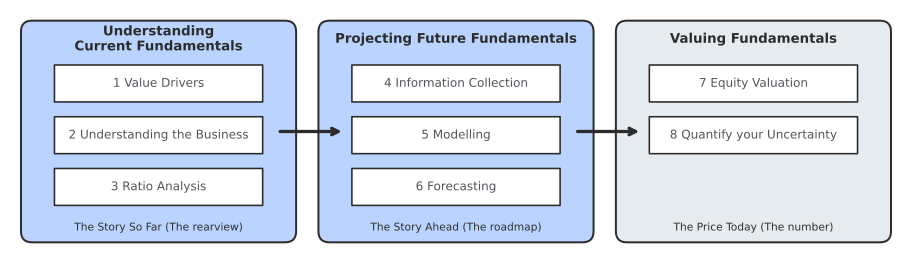
We will discuss how best to build financial models in Chapter 3 to Chapter 6. The key difficulty is devising a model that simplifies the main drivers of a firm’s business model enough to be useful and focus on drivers for which high-quality data can be collected. After years of teaching and performing such analyses, we firmly believe that this is one of the most underappreciated aspects of financial modeling. A complex model for which reliable data cannot be collected is not much better than guesswork. On the other hand, a too simple model—one that does not capture important dynamics—will lead to wrong answers. An additional complication is that analyzes often have to be performed under time and budget constraints. It is an art as much as anything else to find a simple but useful representation of performance drivers for which high-quality data can be collected in time and within budget parameters.