7 Valuation
7.1 Purpose of this chapter
Once we have made our forecasts of future performance, we have almost everything in place to finish our valuation. But we have not yet decided which valuation method to use. Figure 7.1 shows the most common types of valuation methods. Which should we compute? The answer often is: all of them (insofar as applicable).
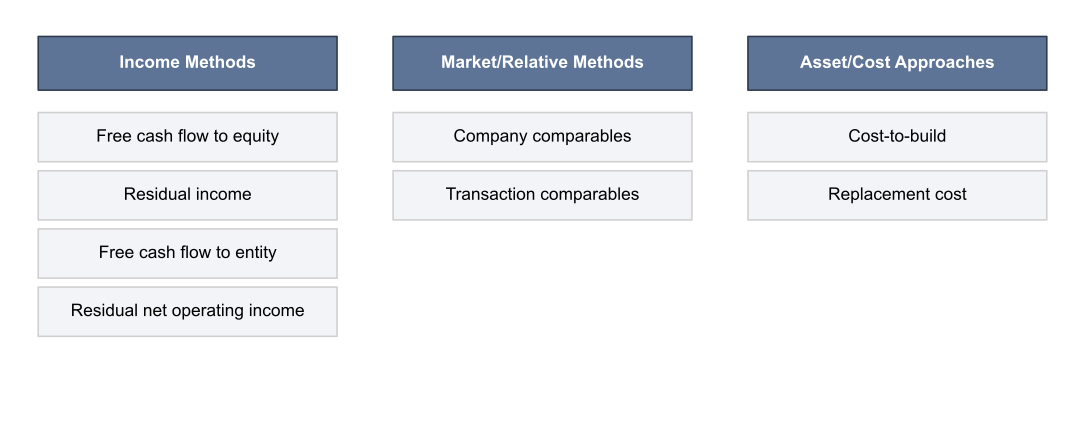
There can be three reasons for using multiple models. First, the full valuation models should give you the same answer, since they are mathematically equivalent if you make the same assumptions. If they do not, then either there is a mistake or you made different implicit assumptions (usually also when computing cost-of-capital). Thus it is a simple sanity check of your model, to ensure that all full valuation models give the same answer. Second, comparing full valuation models with a multiples valuation, or even an asset valuation calibrates your valuation. It often helps in negotiations if you can triangulate the proposed value from multiple angles. You have to be a bit careful here. If you propose a range for your value, then you might have complicated negotiations about which part of the range to settle. The third reason is that if you are in a situation where a counter-party will also submit a valuation, you will want to have a look at all possible valuation methods in order to have an idea how the other side might argue for its valuation.
We might also be in a situation where the people involved in the valuation decision have preferences for one particular approach. The following quote is from a U.S. valuation case in the district of Delaware and expresses such an opinion by the presiding judge1:
“The DCF model of valuation is a standard one that gives, life to the finance principle that firms should be valued, based on the expected value of their future cash flows, discounted to present value in a manner that accounts for risk. The DCF method is frequently used in this court and, I, like many others, prefer to give it great, and sometimes even exclusive, weight when it may be used responsibly.”
— Andaloro v. PFPC Worldwide, Inc., 2005 Del. Ch. LEXIS 125 (Aug. 19, 2005), page 35
The DCF model is indeed the one most often encountered in the U.S.; but, why this is the case might as well be due to its balance between simplicity and sophistication rather than in in-built superiority. As you have now realized, we believe RIM to be more useful because of its transparency. But usefulness is not the issue here. The quote highlights that we need to communicate our valuation using models that are convincing to the recipient of our valuation! If the judge in our case has never heard of the fancy new way we learned to calculate cost of capital, then chances are she will be skeptical and ask us why we do not use an “accepted” method.
The choice of cost capital is often the most contentious in appraisal cases. It also gave rise to this statement:
“The court’s apprehension arises from what Strine calls the ‘status of principles of corporate finance,’ that is, the valuation profession’s continuing but incomplete development of the academic and intellectual principles which underlie valuation methodologies”
— Matthews (2010, 171)
Thus, we will have to be especially careful when building our expectations about the cost of capital. On the one hand, it needs to be in line with our analysis of the business, on the other hand, it needs to follow procedures understood and accepted by the addressees of our valuation report.
Finally, some models are more useful for reverse-engineering expectations build into a valuation. For example, in November 2025. NVIDIA was worth almost as much as the whole German economy (its November 2025 market value being 4.8\(T and the IMF estimate for Germans's GDP being 5.01\)T). Which begs the question, what type of profitability, growth and risk for NVIDA was the market implicitly pricing in? Even if you believe in animal spirits and don’t think investors are always rational, this is an interesting excercise to do to gauge the “amount of irrationality”–potentially a trading opportunity. The RIM models are particularly well suited for this, so we will revisit them too.
To prepare you for all this, we will start by introducing the different valuation approaches. Afterwards we will discuss the last big topic: how to set the cost of capital.
7.2 Full valuation models
7.2.1 Four types of models
Full valuation models are the easiest to tie into investment theory because they all spring from the dividend discount model (DDM):
\[ P_{e,0} = \mathbb{E}_0\left[\sum_{t=1}^{\infty} \left(\frac{DIV_{t}}{\left(1 + r_e\right)^t}\right)\right] \]
- \(P_0\) is the value of the common equity at time \(0\)
- \(DIV_{t}\) is amount of net cash dividends to be paid in period \(t\). Includes stock transactions
- \(r\) is the discount rate
- \(\mathbb{E}_0\left[\cdot\right]\) means everything inside the brackets are uncertain, expected values
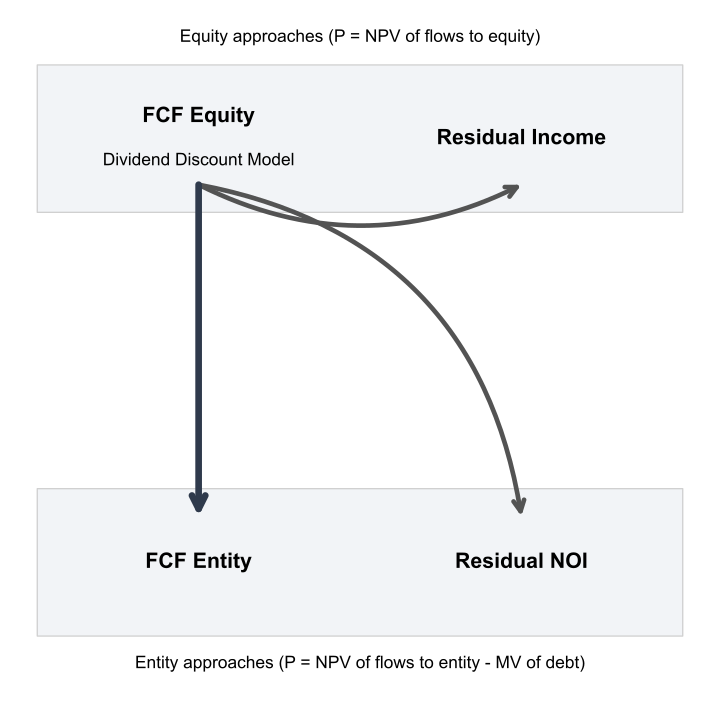
From the basic dividend discount model, we can branch off into three other types of models, as shown in Figure 7.2. There are four different types of models, depending on two choices. The first is whether we want to use an equity approach (computing the value of common equity directly) or an entity approach (computing the enterprise value first and subtract the market value of non-common-equity related capital to arrive at the value of common equity). The second choice is whether we want to use a cash flow-based model or an earnings-based model.
7.2.2 Dividend discount model
The dividend discount model is conceptually the easiest one. Dividends are the cash flows that are eventually received by equity holders, so it is a form of discounted cash flow model. Since it is the cash flow to which shareholders are entitled, it is quite intuitive that the value of common equity should be the discounted sum of all future dividends that the firm generates.
Dividends are also sometimes called free cash flow to equity. The term free cash flow is a bit ambiguous. Often, it loosely refers to the sum of operating cash flows and investing cash flows from the cash flow statement. We can think of this measure as reflecting the amount of cash generated after investments that is free to be distributed to all capital providers. A more precise description would therefore be free cash flow to entity. This distinguishes it better from free cash flow to equity, which is the cash generated and available to be distributed to shareholders. Part of this ambiguity arises because there is more than one way to compute free cash flow to equity.
- + Net income
- − Increase in common equity
- + Cash from operations
- − Increase in cash
- + Cash from investing
- + Increase in debt
- − Dividends paid to minority interest
- − Dividends paid on preferred
- + Increase in preferred stock
- + Dividends paid
- − Net issuance of common stock
The first version uses the clean surplus relation \(CE_t = CE_{t-1} + DIV_t + NI_t\) and adds an adjustment for those cases where the clean surplus relation is violated. The second version rearranges the cash flow statement to isolate the cash available for dividend payment. The third is the most direct. You should test for yourself that all three versions will yield the same free cash flow to equity number.
7.2.3 Residual income model
Using the clean surplus relation, we can reformulate the DDM into the RIM:
\[ \begin{aligned} P_t &= \sum^\infty_{i=1}{\frac{DIV_{t+i}}{(1+r)^i}}\\ & =\frac{DIV_{t+1}}{(1+r)}+\frac{DIV_{t+2}}{(1+r)^2}+\frac{DIV_{t+3}}{(1+r)^3}+\cdots\\ & =\frac{NI_{t+1}+CE_{t}-CE_{t+1}}{(1+r)}+\frac{NI_{t+2}+CE_{t+1}-CE_{t+2}}{(1+r)^2}+\cdots\\ & =\frac{NI_{t+1}-r\cdot CE_{t} + (1+r)\cdot CE_{t}-CE_{t+1}}{(1+r)}+\cdots\\ & =CE_t + \frac{NI_{t+1}-r\cdot CE_{t}}{(1+r)}+\frac{NI_{t+2}-r\cdot CE_{t+1}}{(1+r)^2}+\cdots + \underbrace{\frac{-(1+r)CE_{i-1}}{(1+r)^{i}}}_{0\text{ as } i \rightarrow \infty} \\ &= CE_t+\sum^\infty_{i=1}{\frac{NI_{t+i}-r \cdot CE_{t+i-1}}{(1+r)^i}}\\ &= CE_t+\sum^\infty_{i=1}{\frac{RI_{t+i}}{(1+r)^i}}\\ &= CE_t+\sum^\infty_{i=1}{\frac{(ROE_{t+i}-r) \cdot CE_{t+i-1}}{(1+r)^i}} \end{aligned} \]
As we said numerous times, we like the RIM for its clarity in showing periods of value creation. Assume you can pay €100 for an investment that yields €10 for each future year in perpetuity. Assume an \(r\) of 10%. What is the NPV of the investment? Below you find two valuation models that give exactly the same answer:
DCF to Equity
| 1 | 2 | 3 | 4 | 5 | TV | |
|---|---|---|---|---|---|---|
| CF | 10 | 10 | 10 | 10 | 10 | 10 |
| NPV CF | 9.09 | 8.26 | 7.51 | 6.83 | 6.21 | – |
| NPV TV | 62.09 | |||||
| NPV | = 100 |
Residual Income
| 1 | 2 | 3 | 4 | 5 | TV | |
|---|---|---|---|---|---|---|
| RI | 0 | 0 | 0 | 0 | 0 | 0 |
| NPV RI | 0 | 0 | 0 | 0 | 0 | – |
| NPV TV | 0 | |||||
| NPV | = 0 + BV = 100 |
The DDM (DCF to equity model shows the €10 in “dividends” each period. The net present value amounts of each dividends as well as the net present value of the terminal value. Note how the majority of the value estimate is concentrated in the terminal value, the period we would expect to contribute the least in value generation. This is because cash flows reflect value distribution, not value generation. In sum, the NPV of the cash flows is €100, which equals the original investment. Compare this to the residual income model. The residual income (\(RI\)) in each period is zero because the €10 in dividends reflect a 10% return. Since this is equal to the cost of capital \(r = 10\%\), the value generated is zero. Since we payed €100 for this investment the book value is €100. The value of the investment is those €100 in book value plus 0. This is why the RIM is more expressive. It correctly shows when value is generated, not when funds are distributed. Because this investment has \(ROE = r\), it does not generate value in any period. Its value is just equal to its book value. You could not easily tell this from the DCF model. In short, the advantages in terms of transparency are that it captures more of the value in near-term forecasts. This is especially useful for young firms where an important question is: “When do they start creating value?”
Again, in most cases, you are better of communicating your final model using a DCF method, because that is most likely what your counter-parties feel most comfortable with. But it should not stop you from computing a RIM for your own analysis.
7.2.4 Free cash flow to entity model
The previous two models were equity models. Both have enterprise value counterparts. These estimate the value of the whole enterprise—of the operations as whole—and then subtract the market value of all capital provided by outsiders that are not common equity providers. The rest must, according to standard balance sheet logic, be the market value of common equity.
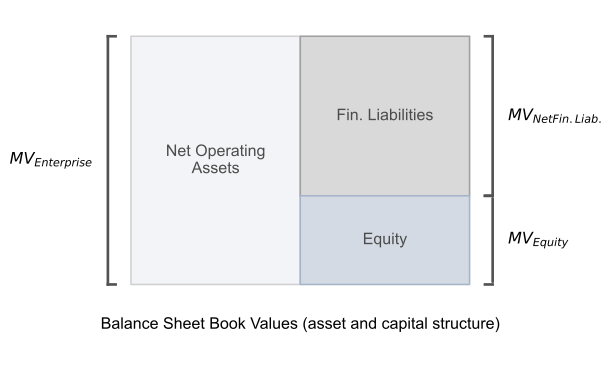
So instead of the free cash flow to equity which calculated the value to equity \(P_e\) directly:
\[ P_{e,0} = \mathbb{E}_0\left[\sum^\infty_{t=1}\frac{FCF_{e,t}}{(1+r_e)^t} \right] \]
The free cash flow to entity models compute the enterprise value and then arrive at the value to equity \(P_e\) via subtraction:
\[ P_{e,0} = \mathbb{E}_0\left[\sum^\infty_{t=1}\frac{FCF_{all,t}}{(1+r_w)^t} \right] - P_d - P_{mi} - P_{ps} \]
Not that we need to apply a different cost of capital now. Before we valued the equity capital, so we needed a discount rate reflecting the cost of equity capital. With entity models (enterprise value models) we value the full amount of invested capital and thus need a different cost of capital measure: the wacc or weighted average cost of capital (\(r_w\) in our formula above). We will discuss cost of capital more in Section 7.4.
Enterprise value approaches are popular in practice. Always remember that the reason is not that one model is “more right” than the other. But enterprise value models are sometimes useful in negotiations. For example, imagine a firm with large pension obligations. It is somewhat easier to value them separately in an enterprise value approach and take them out in negotiations by subtraction.
As with the free cash flow to equity models, there are multiple ways of calculating the free cash flow to entity.
- + EBIT
- − Taxes on EBIT
- + Increase in deferred taxes
- = NOPLAT
- + Depreciation & amortization
- + Non-operating income
- + Other income
- + Extraordinary items & disc. operations
- = Gross cash flow
- − Increase in working capital
- − Capital expenditures
- − Increase investments
- − Purchases of intangibles
- − Increases in other assets
- + Increases in other liabilities
- + Net operating income
- − Increase in net operating assets
- + Cash from operations
- − Increase in cash
- + Cash from investing
- + Interest expense
- − Tax shield on interest
- + Dividends on common stock
- + Interest expense
- − Tax shield on interest
- + Dividends on preferred stock
- + Dividends to minority interest
- − Net issuance of common stock
- − Net issuance of debt
- − Net issuance of preferred stock
It is a good exercise to study these different computation approaches and make sure you understand what they are doing and why they have to arrive at the same number.
7.2.5 Residual net operating income model
If you followed our discussion so far, there is not much left to say about the enterprise value version of the RIM. It uses value-added logic to compute the enterprise value. Since \(RNOA\) and \(NOI\) are our measures of operating profitability and profit at the enterprise level, they take the position of \(ROE\) and \(NI\). Likewise, \(NOA\) is our measure of capital invested into operations and, thus, takes the place of \(CE\):
\[ P_{e,0} = CE_0 + \mathbb{E}_0\left[\sum^\infty_{t=1}\frac{(RoE_{t}-r_e) \cdot CE_{t-1}}{(1+r_e)^t} \right] \]
\[ P_{e,0} = NOA_0 + \mathbb{E}_0\left[\sum^\infty_{t=1}\frac{(NOI_{t}-r_w) \cdot NOA_{t-1}}{(1+r_w)^t} \right] - P_d - P_{mi} - P_{ps} \]
7.3 Reverse engineering expectations
7.3.1 An example, what is implied in NVIDIA’s market cap on April 2025?
The residual net operating model we discussed last is particularly well suited for reverse engineering expectations. Depending on what inputs we have, the equity RIM is also fine. For example, to interrogate NYSE stock prices, we have easier access to consensus analyst earnings forecast rather than consensus forecasts of net operating income. For that reason, in the following example, we will use the equity residual income model.
In November 2025. NVIDIA was worth almost as much as the whole German economy (its November 2025 market value being 4.8$T and the IMF estimate for Germans’s GDP being 5.01$T). Which begs the question, what type of profitability, growth and risk was the market implicitly pricing in? Even if you believe in animal spirits and don’t think investors are always rational, this is an interesting excercise. You would want to gauge the “amount of irrationality”–potentially a trading opportunity. In April 2026, NVIDIA was down to 4.3$T. Its most recent sales number was 216$B with a whopping net margin of 64.5%. Its book value of equity was 157$ B. This is all we need for a small thought experiment. Since value is a function of profit, growth, and risk, if we fix two, we can infer the third. We will do such an excercise now and ask: For a given profitability, cost of equity, and number of years till the AI market matures, what is the implied level of NVIDIA sales for a matured AI market that would justify a 4.3$T market value?
To figure this out, we will use the version of the residual income model that is expressed in terms of sales (derviation here: Equation 2.6) is useful here:
\[ P_0 = S_0 \cdot CapInt_0 + \mathbb{E}_0\left[\sum^\infty_{t=1}{\frac{\left(NetMargin_t-r \cdot CapInt_t\right)\cdot S_t}{(1+r)^t}} \right] \tag{7.1}\]
Let’s turn this into a model with two phases of growth, each with its own constant growth rate. For simplicity, assume a constant abnormal margin \(NetMargin_t-r \cdot CapInt_t = \Bar{AbMargin} ∀ t\)
\[ \begin{align} P_0 &= S_0 \cdot CapInt_0 + \mathbb{E}_0\left[\sum^\infty_{t=1}{\frac{\Bar{AbMargin}\cdot S_t}{(1+r)^t}} \right]\\ &= S_0 \cdot CapInt_0 + \mathbb{E}_0\left[\Bar{AbMargin}\cdot S_0\cdot \left( \sum^h_{t=1}{\frac{(1+g_{s})^t}{(1+r)^t}} + \frac{(1+g_{s})^h\cdot(1+g_{s,TV})}{(r-g_{s,TV})\cdot(1+r)^h}\right)\right]\\ &= S_0 \cdot CapInt_0 + \mathbb{E}_0\left[\Bar{AbMargin}\cdot S_0\cdot \left(\frac{1+g_{s}}{(r-g_{s})} \cdot \left(1 - \frac{(1+g_{s})^h}{(1+r)^h}\right) + \frac{(1+g_{s})^h\cdot(1+g_{s,TV})}{(r-g_{s,TV})\cdot(1+r)^h}\right)\right]\\ \end{align} \tag{7.2}\]
The last line comes from the rules for a finite geometric series:
\[ \sum^h_{t=1}{\frac{(1+g_{s})^t}{(1+r)^t}} = (z + z^2 + z^3 + ... z^h)\,\qquad z^t=\frac{(1+g_{s})^t}{(1+r)^t} \]
\[ \begin{align} z + z^2 + z^3 + ... z^h &= z (1 + z^2 + z^3 + ... z^{h-1})\\ &= z \cdot \frac{(1 - z^h)}{1-z}\\ &= \frac{(1+g_{s})}{(1+r)} \cdot \frac{1 - \left(\frac{(1+g_{s})}{(1+r)}\right)^h}{1-\frac{(1-g_{s})}{(1+r)}}\\ &= \frac{(1+g_{s})}{(1+r)} \cdot \frac{1 - \frac{(1+g_{s})^h}{(1+r)^h}}{\frac{(1+r)}{(1+r)}-\frac{(1+g_{s})}{(1+r)}}\\ &= \frac{(1+g_{s})}{(1+r)} \cdot \frac{1 - \frac{(1+g_{s})^h}{(1+r)^h}}{\frac{(r-g_{s})}{(1+r)}}\\ &= \frac{1+g_{s}}{(r-g_{s})} \cdot \left(1 - \frac{(1+g_{s})^h}{(1+r)^h}\right)\\ \end{align} \]
Let’s plug in the historical values, and values for \(Capint_0=EQ/S=157/216=0.73\), and \(r\) = 9%. We choose 9% for now because this is ca what the average US listed firm trades at in April 2026. We leave \(\Bar{AbMargin}\), \(h\) (the length of the horizon at which sales grow at \(g_s\)) and \(g_s\) open. For \(g_{s, TV}\). With these inputs, the formula above, and a choice for Margin and horizon \(h\), we can use any solver in Excel, Python, etc. to back out the implied sales level for NVIDIA at the assumed year h. We did this. Below you find those implied sales levels.
| Margin | 5 | 6 | 7 | 8 | 9 | 10 | 15 | 20 |
|---|---|---|---|---|---|---|---|---|
| 45.0% | 799,508 | 842,500 | 887,953 | 936,022 | 986,871 | 1,040,671 | 1,360,664 | 1,786,818 |
| 50.0% | 701,997 | 738,373 | 776,766 | 817,300 | 860,103 | 905,312 | 1,172,738 | 1,525,740 |
| 54.5% | 631,865 | 663,540 | 696,921 | 732,110 | 769,212 | 808,338 | 1,038,663 | 1,340,302 |
Table 7.2 shows the implied sales levels. For example, at a whopping constant 54% net margin and assuming it will take the AI market reach a mature, stable level with ca 3% growth annually thereaafter, the implied sales level for NVIDIA is 631$B in 2030. As a next step, we would need to reason about which market size of the AI market would be consistent with NVIDIA
Formulas and exercises like this are worth pondering. They provide insights that are not always immediately intuitive. For exmaple, if we assume it will take longer for NVIDIA’s market to mature, the implied sales level is actually bigger. Why is that? First the goal posts change. For h=5 and h=20, we are comparing different horizons (631B in 2030 versus 1340 in 2045). Intuitively, this tells you that you should only assume a longer horizon till maturity, if you also assume that the AI market will be bigger. Mechanically this has to do with the trade-off between growing at \(g_s\) for h periods and 3% thereafter. See the table below.
| Margin | 5 | 6 | 7 | 8 | 9 | 10 | 15 | 20 |
|---|---|---|---|---|---|---|---|---|
| 45.0% | 29.9% | 25.5% | 22.4% | 20.1% | 18.4% | 17.0% | 13.1% | 11.1% |
| 50.0% | 26.6% | 22.7% | 20.1% | 18.1% | 16.6% | 15.4% | 11.9% | 10.3% |
| 54.5% | 24.0% | 20.6% | 18.2% | 16.5% | 15.2% | 14.1% | 11.0% | 9.6% |
As a precursor to the next chapter on cost of capital, let us examine what would happen if we increase the cost of equity. Arguably, NVIDIA is riskier than the average US firm. The range of publicly available cost of equity estimates ranged from 8.1 to 14.3%. If we increase the cost of equity to 12%, you will notice how the required sales levels explode. This is a common theme in NPV calculations. Valuations are sensitive to the discount rate. This is also true for our reverse engineering excercise
| Margin | 5 | 6 | 7 | 8 | 9 | 10 | 15 | 20 |
|---|---|---|---|---|---|---|---|---|
| 45.0% | 1,380,023 | 1,483,941 | 1,596,206 | 1,717,562 | 1,848,802 | 1,990,783 | 2,897,198 | 4,251,423 |
| 50.0% | 1,201,409 | 1,289,066 | 1,383,594 | 1,485,590 | 1,595,691 | 1,714,582 | 2,469,156 | 3,586,088 |
| 54.5% | 1,074,579 | 1,150,823 | 1,232,913 | 1,321,348 | 1,416,657 | 1,519,409 | 2,168,213 | 3,120,767 |
| Margin | 5 | 6 | 7 | 8 | 9 | 10 | 15 | 20 |
|---|---|---|---|---|---|---|---|---|
| 45.0% | 44.9% | 37.9% | 33.1% | 29.6% | 26.9% | 24.9% | 18.9% | 16.1% |
| 50.0% | 41.0% | 34.7% | 30.4% | 27.3% | 24.9% | 23.0% | 17.6% | 15.1% |
| 54.5% | 37.8% | 32.2% | 28.3% | 25.4% | 23.2% | 21.5% | 16.6% | 14.3% |
7.3.2 Constant growth formulas for back-of-the-envelope computations
7.4 Cost of capital
7.4.1 What is risk
A final issue we need to talk about is how we find the cost of capital to our model—either \(r_{w}\) for equity models or \(r_{w}\) for entity models. What is cost of capital (\(COC\)) in the first place? The following two statements are equivalent:
- \(COC\) is the expected rate of return you demand for holding a certain level of risk
- \(COC\) is the expected rate of return you could earn on your next best alternative investment with equivalent risk
The “certain level of” and “equivalent risk” portions of the two statements are where the practical issues are hidden. How do we measure those? There are ideas that we first need to tie down. The first is that risk relates to your distaste for uncertainty in future payoffs. The second is that not all risk is priced in the market. That is, there are risks that you can demand a discount for when taking it on and risks that you cannot demand a discount for.
Let us discuss the first idea: risk is your distaste for uncertainty. We begin with a question: Do you prefer A: $1 million or B: 50% Chance of $2 million and 50% Chance of $0?. if you are a human being with a concavely shaped utility function, such as the one shown in Figure 7.4 then the answer has to be: You prefer the sure payoff.
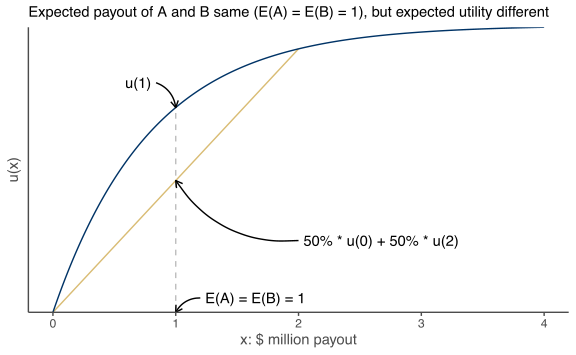
In fact, in economic preference theory, the sole reason that we have this preference for certainty is because we assume most utility functions regarding payoffs are concave shaped—Every additional € of payoff satisfies less than the one before. This assumption leads to the concave shape. And the concave shape leads to expectations of uncertain payoffs to be below the utility curve. This leads us to prefer sure outcomes over linear combinations (e.g., \(Pr\left\{x = 0\right\} * u(0) + Pr\left\{x = 2\right\} * u(2)\) in Figure 7.4).2
The second important idea is that not all risk is risk that we can demand compensation for. Risk that can be diversified away is risk that is not priced. The basic idea was already shown in Figure 2.8, shown again below as Figure 7.5.
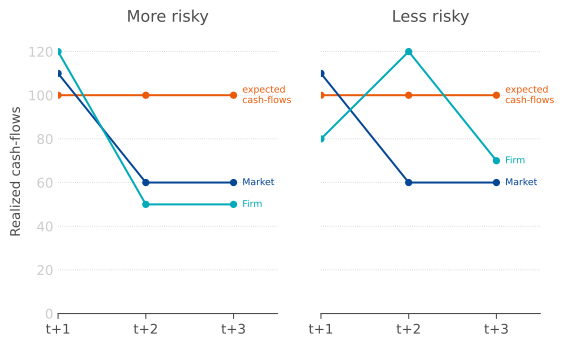
Consider the shares of a firm (firm A) and some measure of ‘the market’ (e.g., the performance of the S&P 500 or the MSCI World Index ETF). Figure 7.5 shows three simulated scenarios. The left panel shows the scenario where firm A is strongly positively correlated with the market, the midel panel shows the scenario with no correlation, and the right panel shows the very rare scenario of a very acyclical firm (strong negative correlation). Both price series are normalized to 1 on trading day 1.
All three panels further show you what would happen if you would build a portfolio that contains firm A shares and market ETF shares in equal proportions. You see that in the left panel, it does not really matter whether you hold firm A, the market, or the portfolio. You would get very similar performance. This is due to the strong correlation and one simplifying assumption we made in the simulation. Both the firm and the market have the same average daily return (0.04%) and standard deviation (1.5%). In the middle panel, the portfolio’s performance is much less volatile (the sample standard deviation goes from 1.53 to 1.09). This is even more pronounced in the right panel. Because the firm is acyclical its performance partially counters the ups and downs of the market, leading to a much smoother line, trending around the common mean daily return of 0.04%.
As an investor, you actually really only care about the performance of the portfolio – not about the performance of individual assets. The riskiness of individual assets (and the price you are willing to pay for taking on this risk) should thus depend on how including it would change the uncertainty of the expected performance of your portfolio.
In modern asset pricing we assume that there are some risk factors that assets are exposed to (correlated with). Intuitively the definition of risk as used in modern asset pricing can be understood as: cash flows that are more uncertain and that are more likely to not materialize when you need income are riskier.3 In standard asset pricing models (with deep markets and a large number of firms), such ‘systematic risk’ is the only risk that investors receive a ‘price discount’ for holding it. If the uncertainty is ‘idiosyncratic’ (not correlated with your future need for income) and you want to pay a lower price for the stock, you will not get your wish. Another, better-diversified investor will offer a higher price for the stock. Since she is more diversified, the idiosyncratic risk is less relevant to her. Thus, she will offer a higher price, and you have to match or not get the stock.
7.4.2 Cost of equity capital
Such systematic risk is priced according to asset pricing theory. But it is still an open issue to identify and quantify what the systematic components are. The standard approach in most valuation practice is to try to sidestep the issue by looking at how the market has historically compensated investors for bearing risk. That is the rationale for using historical return relations with factors assumed to capture some systematic risk factors, like market swings. For example, the capital asset pricing model (CAPM) defines cost of equity capital as:
\[ \begin{aligned} r_e & = \text{risk free rate}(r_f) + \text{risk premium}\\ & = r_f + \beta \cdot \text{equity risk premium} (ERP)\\ & = r_f + \beta \cdot \mathbb{E}\left[r_{market} - r_f\right] \end{aligned} \tag{7.3}\]
In the U.S. “CAPM is the prevalent method since 1990 Technicolor decision”4. The same goes for Europe, which is why we focus on it here. The intuition behind Equation 7.3 is the same as the one in Figure 7.5. \(ERP\) captures the price of taking on market risk—uncertainty due to unforeseen changes in market performance. According to the CAPM unforeseen market swings is a systematic risk that you cannot escape. Firms have just more or less exposure to this risk, which is captured by their \(\beta\).
There are various ways to compute \(r_e\) along the lines of the intuition provided by the CAPM. A good discussion is found in Koller et al. (2020). The risk free rate \(r_f\) reflects what an risk-free instrument with a duration similar to the cash flows of the firm would earn. Most often, a fairly liquid 10-year government bond yield is used as an approximation.5 Because of the current low interest rate environment, just applying the low current bond yields as estimates of \(r_f\) would lead to much lower cost of capital and, thus, higher valuations than currently observed in public markets. Current practice is to adjust these rates by an estimate of inflation and call them synthetic risk free rates.
For estimates of the \(ERP\), we often rely on historical estimates. Historical estimates of market returns between ca. 6%-8% are computed and used as forecast for expected market returns. The \(ERP\) is thus commonly assumed to be around 5%-7%.6 Finally, \(\beta\) is usually based on historical estimates using five years of monthly returns for listed firms. For firms without a stock return history available, there is only the option to choose comparable publicly traded companies as benchmarks or refer to one of the many reference books popular in practice.
Sometimes CAPM estimates are adjusted for industry-specific or firm-specific risks. This is a thorny issue. Remember that only systematic risk is priced. Normal firm-specific risk should be diversifiable. Such adjustment, if not based on a very convincing argument for a firm’s exposure to an important and obvious systematic risk factor, are often challenged.
At this point, we refrain from spending more space on the specifics of computing \(r_e\), even though these estimates clearly matter and can drastically change value estimates. Cost of capital estimates are quite often reasons for disputes in appraisals, like in the following quote:
“In calculating the risk premium, [petitioner’s expert] used the relatively new research by Fama and French to find a value of 4.5%. In contrast, [respondent’s expert] employed the older and more widely accepted practice of using the Ibbotson Associates data and used a value of 7.3%. The Company’s main argument against the use of the Fama and French research is that because it is ‘brand-new’ and ‘still under significant academic debate’ it cannot satisfy the standard that a valuation methodology be ‘generally considered acceptable in the financial community,’ as required by Weinberger v. UOP. The mere fact that it is new does not make this research unreliable or outside of the Weinberger standard. A valuation such as this is built on assumptions that will always be under debate or attack in the academic community.”
— Vice Chancellor Noble in Cede & Co. v. MedPointe Healthcare, Inc., 2004 Del. Ch. LEXIS 124 (Sept. 10, 2004), page 69-70
The quote is from cases around the time when U.S. courts opened up the Fama-French model of estimating cost of capital (20 years after its publication). More importantly, it shows how different estimates can be and that significant disputes can arise—with sometimes perplexing arguments being brought up to dispute or argue for one estimate rather than the other. This is one of the areas where a good understanding of the institutional “tastes” is crucial for a successfully defended model (while still adequately portraying the business model’s riskiness of course). And of course a firm grasp of the theory and economics that a cost of capital estimate is supposed to capture will help you come up with good arguments for defending estimates. But that is why we do not go more into the specifics of calculating the cost of capital here, given the capacity limit for topics to discuss in detail. We chose to spend most more time on forecasting details and the intuition behind cost of capital estimates, where we believe we can add more value, and kindly refer readers to the many detailed corporate finance textbooks on estimating cost of capital.
7.4.3 Weighted average cost of capital
For enterprise value models we need a different cost of capital; we need \(r_w\) the weighted average cost of capital or \(WACC\). The logic is pretty simple. Since the enterprise value reflects the value of the operations, we need a cost of capital measure that reflects the riskiness of the operations. The riskiness of the business and the riskiness of the equity in the business can differ due to leverage effects. Even though there are some operating beta approaches out there that try estimate the riskiness of operations directly, they are not very common. The most common approach is to make use of the fact that in a competitive market, the riskiness of the operations should be approximated by the weighted average of the cost of capital to all capital providers that contributed to the capital invested (debt, preferred stock, minority interest, common stock, etc.) This is one outcome of the famous capital structure theory of Modigliani and Miller (Modigliani and Miller 1958). Equation 7.4 shows a typical \(WACC\) formula:
\[ r_w = \frac{r_e P_e + r_{ps} P_{ps} + r_{mi} P_{mi} + (1-tx) r_d P_d}{P_e + P_{ps} + P_{mi} + P_d} \tag{7.4}\]
- \(tx\): estimated marginal tax rate on income
- \(r_{e}\): estimated cost of equity capital
- \(r_{ps}\): estimated cost of minority capital
- \(r_{mi}\): estimated cost of preferred stock capital
- \(r_{d}\): estimated cost of debt
- \(P_{e}\): estimated value of the equity
- \(P_{d}\): estimated value of the debt
- \(P_{ps}\): estimated value of the preferred stock
- \(P_{mi}\): estimated value of the minority interest capital
There are some conceptual issues and misunderstanding with \(WACC\). The biggest ones relate to the weights that result from forecasts of the capital structure. First, for a constant \(WACC\) one needs to assume a constant (target) capital structure. If you expect big changes in capital structure, then a constant \(WACC\) will be incorrect.7 Second, one common issue is how to set the target capital structure. Often the ratio of debt to equity using market values is used. However, conceptually, the weights should be based on the true value, not the market values, as per Modigliani and Miller (1958). Of course, the value of equity is what we want to estimate! If it differs from the value (e.g., the market value) that we use to compute the weights in the \(WACC\) then we have a logical inconsistency. One often posed suggestion around the issue is that the current ratio of market values could be a good proxy for a target capital structure of the firm. See, for example, (Koller et al. 2020). For firms with large changes in capital structure, the current rates will give a poor proxy of the weighted average cost of capital based on such a target structure. However, if we believe the capital structure irrelevance arguments by Modigliani and Miller (1958), then this should not matter. Recall that the true riskiness of the operations—or worded differently, the riskiness of \(NOI\) or \(FCF_{entity}\)—should not change with capital structure. Weight changes will cancel out with changes in the cost components due to the capital markets repricing the components. We use capital structure irrelevancy as a working assumption. If we do not trust this theory, then we have many other issues to deal with. The issue remains what equity value to put into the formula above. We prefer to find this value iteratively and by comparison to an equity-based model.
7.5 Multiples valuation
Valuation ratios express value as a multiple of some financial metric:
“If comparable company X trades at 5x EBITDA with an EBITDA of 1, and we apply the same multiple to our company’s EBITDA of 2, then it is worth at least 10.”
Multiples are frequent and often used for comparisons. Common use-cases are:
- Comparing traded equities to determine which one is most attractively priced
- Determining the value of businesses that are not publicly traded
- Evaluating the reasonableness of M&A proposals
However, multiples, due to their simplicity, have to be handled with great care. We need to understand what they might be picking up when framing some value as a multiple of a sometimes seemingly arbitrarily chosen performance metric. We can get a better handle on the most common ratios by re-arranging our valuation models. In this way, we can identify the determinants of common valuation ratios. Working through the algebraic proofs is not particularly important, but the intuition behind the resulting expressions is useful. Let us begin with the most common ratio, the price earnings ratio.
7.5.1 Price-Earnings ratio
\[ \frac{P_{e,0}}{NI_0} = \frac{1 + r_e}{r_e} \left(1 + \sum^\infty_{t=1}{\frac{ 1 }{(1+r)^t}} \cdot \underbrace{\frac{ \triangle RI_t}{NI_0}}_{\text{Growth in residual income}} \right)- \frac{D_0}{NI_0} \tag{7.5}\]
In Equation 7.5, \(\frac{D_0}{NI_0}\) is the dividend payout ratio. The key to a high price-to-earnings ratio is growth in residual income. However, for residual income to grow, net income must grow faster than expected earnings. This means either increasing future \(ROE\) or growth in equity capital given \(ROE > r_e\). So, nothing we did not know before. There is also an often used benchmark, the case of no growth-no dividends. \(\frac{P_{e,0}}{NI_0} = \frac{1 + r_e}{r_e}\). This is often used to reason about lower bounds of a valuation. For example, for \(r_e=10\%\) P/E is 11.
There is an important insight buried in the formula, though. Let us simplify a bit in order to make it more transparent. Assume for simplicity that we have a forecast for next year’s earnings \(NI_1\) and we assume a fixed yearly growth rate for residual earnings (\(g_{RI}\)). Equation 7.5 then simplifies to:
\[ \begin{aligned} P_{CE, 0} &= CE_0 + \frac{NI_1-r_{CE}\cdot CE_{0}}{r_{CE}-g_{RI}}\\ \frac{P_{CE, 0}}{NI_1} &= \frac{1}{r_{CE}-g_{RI}} \cdot \left( 1 - \frac{g_{RI}}{RoE_1} \right) \end{aligned} \]
Dividing both sides of the first equation by \(NI_1\) and rearranging the terms yields a simpler expression for the price-earnings ratio. It shows that the usual value drivers determine the P/E multiple. The same goes for other multiples; one can do very similar reformulations for EV/EBIT, etc. It is also intuitive. A good candidate for a comparable company should have a similar profile in terms of risk (\(r_{CE}\)), growth (in abnormal profitability \(g_{RI}\)), and profitability (\(RoE\), return on equity).
The formula above does not have a very intuitive form though, so let us plot it for reasonable ranges of \(r_{CE}\), \(g_{RI}\), and \(RoE\). The result is shown in Figure 7.6:
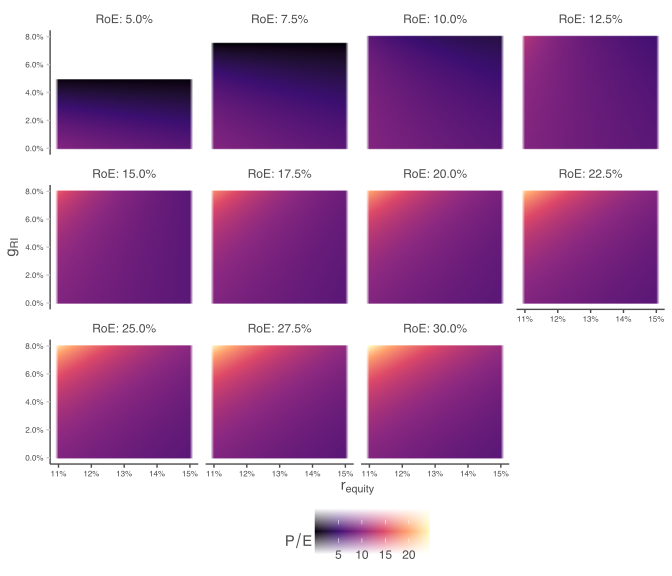
The important takeaway is that all three drivers interact to determine the level of the P/E ratio. This is especially obvious in the high-\(g\) upper left corners of the different plot panels. Importantly, the slope in each panel is different. Thus, only because two companies might have similar P/E ratios, they might not have similar changes in P/E ratios if they have different combinations of the three core value drivers. Thus, it is important for multiple comparisons to pay attention to the comparability across all relevant dimensions. The same holds for all ratios discussed now.
7.5.2 Price-Earnings-Growth ratio
This ratio was popularized partly by Peter Lynch, who wrote:
“The P/E ratio of any company that’s fairly priced will equal its growth rate”
— Peter Lynch, One Up on Wall Street, 1989
We can again try to provide more intuition for this ratio by rearranging our valuation formulas:
\[ PEG = \frac{P_0 / NI_1}{g_e \cdot 100} = \frac{P_0 / NI_1}{\frac{NI_5 - NI_1}{NI_1} \cdot 100} = \frac{P_0}{(NI_5 - NI_1) \cdot 100} \tag{7.6}\]
The idea is that a \(PEG=1\), signals that the firm is correctly valued, a \(PEG < 1\) signals undervaluation, and a \(PEG > 1\) overvaluation. Note the last reformulation in Equation 7.6. The \(PEG\) really compares price with changes in earnings over a certain period. This is a bit of a weird one. Shaky theoretically but popular in practice.
7.5.3 EV-to-EBITDA ratio
This is a very popular metric. Using the fixed, limited growth version of the FCF Entity model, we can see what might be driving the EV-to-EBITDA ratio:
\[ \begin{aligned} EV &= \frac{FCF_{all,1} \cdot \left(1 - \frac{(1+g)^n}{(1+r_w)^n}\right)}{r_w - g} + \frac{FCF_{all, n+1}}{(r_w - g_\infty) \cdot (1+r_w)^n} \\ \frac{EV}{FCF_{all,1}} &= \frac{ \left(1 - \frac{(1+g)^n}{(1+r_w)^n}\right)}{r_w - g} + \frac{(1+g)^{n-1}(1 + g_\infty)}{(r_w - g_\infty) \cdot (1+r_w)^n} \end{aligned} \]
Similar to the P/E ratio, EV/\(FCF_{all,1}\) a function of risk and \(FCF\) growth (instead of \(RI\) growth). Most find \(FCF_{all,1}\) too complex/messy and use proxies s.a. EBIT, EBITDA instead. Note, that there are predictable differences between \(FCF_{all,1}\) and these shortcuts. E.g., EBITDA does not account for investments. We personally do not use this ratio a lot because we find it difficult to really argue about firms being “comparable in terms of WACC and FCF growth” A \(NOPAT\) ratio would be easier, but is uncommon.
7.5.4 Market-to-Book ratio
\[ \frac{P_{e,0}}{CE_0} = 1 + \mathbb{E}_0\left[\sum^\infty_{t=1}{\frac{\underbrace{(RoE_{t}-r)}_{\text{abnormal profitability}} \cdot \underbrace{\frac{CE_{t-1}}{CE_0}}_{\text{growth}} }{(1+r)^t}} \right] \]
This formula, with \(\frac{CE_{t-1}}{CE_0} = \prod_{\tau}^{t-1}(1+g_\tau)\) representing cumulative growth, should look familiar as we have encountered it in Section 2.7 to provide intuition for why profitability and growth interact. The key to a high market-to-book ratio is:
- Generating a long-run ROE that exceeds the cost of capital
- Growing the size of the investment base on which the ROE is generated
In summary, valuation ratios are simple heuristics. They are not a substitute for thorough valuation analysis. Importantly, we also need to assume that our comparable is correctly priced! If they are not, multiples are a sure way to inflate price bubbles. Multiples are complicated functions of our value drivers. Valuation ratios can be useful for preliminary assessments of the expectations about future fundamentals that are built into stock prices. A final word of caution is that all multiples are heavily influenced by cost of capital. This is nearly always ignored when the choice of comparables is made.
7.6 References
The courts of Delaware, due to the large amount of companies incorporate in Delaware, often sets precedents in U.S. valuation decisions.↩︎
By now there is a rich history in behavioral economics examining how utility functions of actual people look like. Oversimplifying and overdramatizing a bit, big questions discussed are whether we are best described as greedy or jealous (whether absolute wealth matters for utility or wealth relative to some benchmark) and whether impatience is something distinct from uncertainty. This area is fascinating. We encourage intellectually curious business and economics students to engage with this literature. However, the insights out of behavioral economics are still to some extent debated and make the question of what is the cost of capital even more complex. To our knowledge, the debate has not impacted valuation practice either, which is why we do not cover it further.↩︎
This is our attempt to explain in simple terms the idea behind consumption based-asset pricing theory.↩︎
Cede & Co. v. Technicolor, Inc., 1990 Del. Ch. LEXIS 259 (Oct. 19, 1990), p. 92–100, rev’d on other grounds, 634 A.2d 345 (Del. 1993). A case which according to footnote 12 of Matthews (2010), “spawned 17 Chancery and Supreme Court decisions over a 20-year span”.↩︎
Thus, if we would want to be absolutely precise, each period would have its own discount rate. The cash-flows or residual income in period \(t+4\) would have a discount rate that matched the risk with duration of four years, the cash-flows or residual income in period \(t+10\) would be discounted with a discount rate incorporating a 10-year duration, and so on. This is seldom possible. 10-year bond yields are a good compromise between duration and liquidity trading—implying more robust pricing.↩︎
The magnitude of equity risk premium is still subject to disagreement (see e.g., this note). Koller et al. (2020) provide good arguments for a 5% ERP, other references like the SBBI yearbook have a 7% ERP↩︎
While there are approaches to account for this, most are very cumbersome and outside of what we have time for in this course.↩︎