3 Understanding the Business
3.1 Purpose of this chapter
In the previous chapter, we argued that the heart of a good valuation is a good forecast. More precisely, we want good forecasts of future return-on-equity, capital invested, and risk. Of course, a forecast is only as good as the information and reasoning that went into it. The next important question is thus “what information do we need?” To answer this question, we first need to understand the business. This chapter introduces our thinking, trying to link core value drivers, the concept of competitive advantages, and financial statements into one coherent analysis.
3.2 What information do we need?
Before we proceed, we need to orient ourselves. An often discussed question is: “How much of a firm’s performance is driven more by the industry rather than the firm itself?” As this has implications for which topic an analyst should spend her valuable time on (industry analysis versus firm analysis), we should discuss this first.
To ground our answer in some data, consider the decomposition of individual stock returns (\(Ret_{i,t}\)) into three parts, as expressed in Equation 3.1:
\[ Ret_{i,t} = \overbrace{a_{1,i}}^{\text{Market exposure}}\cdot MktRet_{i,t} + \overbrace{a_{2,i}}^{\text{Industry exposure}}\cdot IndRet_{i,t} + e_{i,t} \tag{3.1}\]
\(e_{i,t}\) reflects the firm-specific component in stock returns, \(a_{1,i}\) reflects a stock’s exposure to market-wide movements, and \(a_{2,i}\) reflects a stock’s exposure to its industry movements. Figure 3.1 shows this decomposition based on 1168 listed stocks from the three major US stock markets and using daily returns during the year 2018.
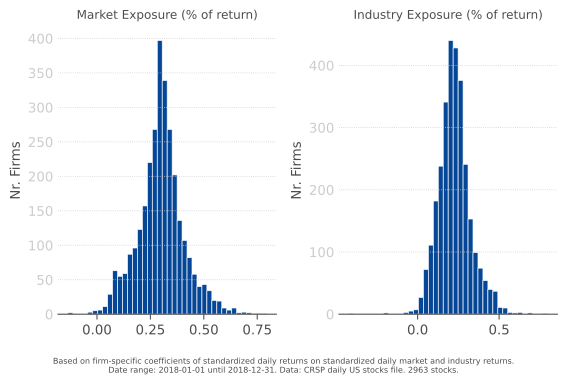
Figure 3.1 shows that the average market exposure is about 30% and the average industry exposure is about 20%–25%. The numbers imply that for the average firm ca. 50% of daily stock movement is attributable to firm-specific news rather than industry or market news. The figure also shows that there is a great deal of heterogeneity between firms with respect to that number. Still, the takeaway is that while industry analysis is clearly important, firm-specific events are often of first-order importance.
What information do we then need to collect in a business analysis? The answer likely differs from firm to firm, but the following general approach has served us well:
- What markets does the firm operate in? (\(g\), \(r\))
- What is the firm’s business model? How does the firm try to make money in these markets? (\(ROE\))
- What is the firm’s strategy for securing sustained high profitability? What are the competitive advantages/disadvantages? (\(ROE\), \(r\), \(g_{CE}\))
- How successful is the firm with that strategy? (\(ROE\), \(r\), \(g_{CE}\))
- How operationally efficient is the firm? (\(ROE\))
As we will discuss now, a careful analysis of a firm’s financial statements is usually a key step in answering these 5 questions.
3.3 Business strategy
Our first couple of questions are: What are the markets, what is the business model, and what is the firm’s strategy for creating and maintaining competitive advantages? The answers to the questions are key for our forecasts of future return-on-capital-invested. Most importantly, only if there are sustainable competitive advantages can a firm be expected to maintain a \(ROE\) greater than \(r\). Figure 3.2 illustrates the \(ROE\) vs \(r\) dynamics that we expect for a typical firm with no sustainable competitive advantages

As a firm scales into the market, unit economics will drive up its \(ROE\). However, if the \(ROE\) is high enough and it becomes obvious that this market represent a lucrative business opportunity, competition will enter the market. More competition means margins get pressured, reducing \(ROE\). And there is a second force. As the market of the firm matures, it becomes harder to grow just by scaling. The more the market saturates, the more additional growth has to come from taking market share from competitors, increasing the amount of competitive pressure. The only way to get around this is to continuously expand into new markets for growth.
Figure 3.2 illustrates why understanding a firm’s competitive set of potential competitive advantages is crucial. So we need a framework to think about those. The following discussion of what to look for generally follows the arguments made by Greenwald and Kahn (2005). First, we should clarify which firm decisions we consider strategic decisions and which we consider operating decisions. Table 3.1 replicates Table 1.1 from Greenwald and Kahn (2005), which provides a nice overview of important differences between strategic and operating decisions. At its core, strategic decisions are about what business a company wants to be in and how it wants to compete–how it wants to create and defend competitive advantages that allow it to create value. Operating decisions in turn are about how to best execute this strategy.
| Strategic Decision | Operational Decisions | |
|---|---|---|
| Management level | Top Management, board of directors | Midlevel, functional, local |
| Resources | Corporate | Divisional, departmental |
| Time frame | Long-term | Yearly, monthly, daily |
| Risk | Success or even survival | Limited |
| Questions | What business do we want to be in? What critical competencies must we develop? How are we going to deal with competitors? | How do we improve delivery times? How big a promotional discount do we offer? What is the best career path for our sales representatives? |
Here are two examples of strategic decisions:
- Which markets to enter and exit. In the 80s, IBM decided to outsource operating system development and chip manufacturing to two small companies—Those two are now Microsoft and Intel
- Which part of the value chain to be invested in. In 2014, Netflix decided to start producing its own shows. Whoever controls the content has the bargaining power?
In contrast, Peloton Interactive Inc.’s issues in 2021 are operating issues. Peloton sells home workout equipment, mostly stationary bikes, with an integrated screen and a subscription to online workout classes. Demand first far outstripped Peloton’s expectations during the Covid pandemic, which led to supply shortages. Peloton increased production and logistic capacity, but apparently got caught unprepared by a slump in demand, as Covid restrictions eased. Peloton was left with excess capacity it did not need and a too high cost structure. This combination of first underestimating demand, then overestimating demand and building capacity is an operating issue, which ultimately led to the CEO stepping down.
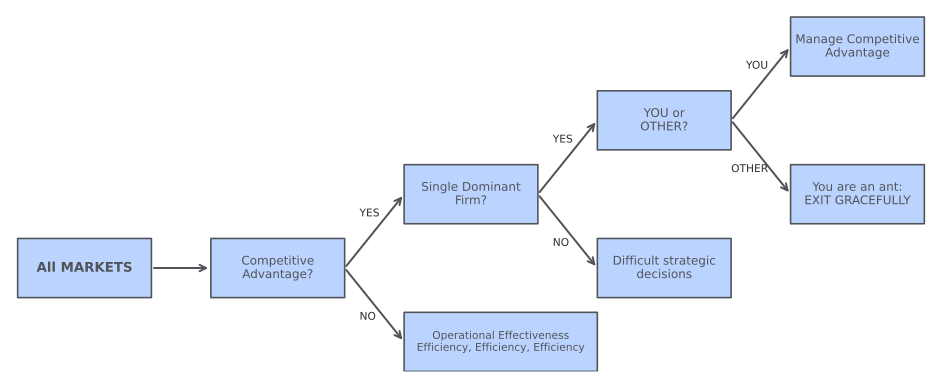
Framing our thinking and analysis in terms of \(ROE\) and its relation to competitive advantages and disadvantages helps us focus on what is crucial in the long run. Figure 3.3, again taken from Greenwald and Kahn (2005), exemplifies common business thinking: whether a firm even wants to operate in a market depends purely on competitive advantages.
To better understand what we are looking for when examining financials and other information, it is helpful to classify different kinds of competitive advantages. Table 3.2 provides the classification by Greenwald and Kahn (2005).
| Type | Description | Sustainability |
|---|---|---|
| Supply | Cost advantages. E.g., proprietary technology, etc. | Difficult to sustain |
| Demand | Access to market demand that competitors cannot match. This is about customer captivity (e.g., habits, costs of switching, search costs, etc.). | Often easier to defend |
| Econ. of Scale | Decreasing costs per unit as volumes decline. | Vulnerable to big players |
Supply advantages are usually some kind of proprietary production technology, or something similar, that enables the firm to produce the goods or deliver the service at cheaper costs than competitors can. While initially powerful, these tend to disappear at some point as technology advances.
Demand advantages can be long-lasting. If customers can be locked in (either via habit formation, network effects / switching costs, search costs), then such a lock in can be defended for a long time (usually till the market for the good or service disappears).
Economies of scale are a bit of an outlier in this list. Economies of scale usually arise when the costs of production/servicing are largely fixed and are often the basis for the claim of a “first-mover advantage”. An extreme example is developing software. Software is developed once, and each additional app sold does not significantly increase the cost of development.1 As a result, the cost per unit sold decreases with more units sold. Consequently, whoever has the highest market share can produce at lower average cost than any competitor—an advantage hard to overcome by the smaller competitors. Or is it? It depends on how large the financial firepower of that competitor is. Does Netflix’s first-mover advantage hold against the financial firepower of the much larger Disney? Every customer that the incumbent with economies of scale loses to the competitor increases the incumbent’s average cost per unit sold and decreases the competitor’s average cost per unit sold. Economies of scale alone may not be enough to keep competition at bay.
In terms of thinking about \(ROE\), there are some combinations of competitive advantages that are 1) hard to overcome by competition and 2) lead to high \(ROE\)s. Most notably, the combination of demand advantages and economies of scale in a large market usually leads to very high profitability and is difficult to overcome barriers to competition. Think Microsoft Office.
It is also important to remember that creating and sustaining competitive advantages is not costless. Firms like to point to their brands as a competitive advantage because it grants access to a particularly attractive segment of the market (e.g., Ferrari) or because it reduces search costs, etc. But a brand has to be built, often via significant advertising and marketing campaigns. The costly investments in brand building could still lead to a situation where in a competitive market \(ROE \approx r\).
3.4 Using financials to understand a business
Remember our questions from the beginning of the chapter. In what markets does the firm operate in? What is the business model? How does the firm try to make money in these markets? What is the firm’s strategy to secure sustained high profitability? What are the competitive advantages/disadvantages? How successful is the firm with this strategy? How operationally efficient is the firm? Now that we know a bit better what to look for, what information can we get from financials? This obviously depends on the reporting requirements. In most jurisdictions, listed companies have to provide audited business descriptions, which is usually a good starting point for answers to the questions: In what markets does the firm operate in, what is the business model, etc. This is not the case for small private companies. Here we need even more external information.
Once we have an initial idea about the markets the company claims to be in, we prefer to look at the balance sheet and income statement next.
3.4.1 Look for remarkable items
When looking at the balance sheet and income statement, we are first interested in what the big positions are in both. They are good indicators of important parts of the business. For example, when looking at the financials of a department store chain with a lot of acquisition and divestment activity and a large chunk of gains coming from real estate related transactions, you will probably start to wonder whether the department store chain’s main business is running department stores or dealing in real estate property. The financials will tell you the answer. We also look for items or positions that are not in line with what we expect to be there. (A restaurant chain with a large position in notes receivables? Where is that coming from?)
We can often also find first hints on what the company’s strategy for competitive advantages are. We need to perform a more detailed ratio analysis to do this properly (which we will discuss in Chapter 4, Information Collection), but there is much that one can learn from a quick glance at the financial statements. Outsized expenses on customer acquisition costs? Maybe a sign of the company trying to get to economies of scale fast. A follow-up question would then be: What activities are behind these acquisition costs? How exactly are these customers acquired? Does it make sense strategically?
You will not always be surprised. If it is a simple company doing what it says it is doing, the financials will look exactly how you would expect it—and that is what you want to see. Also, not all financial statements are equally informative. Requirements to provide information differ by country, between listed and unlisted firms, and often by size. There is also leeway for companies to be more or less transparent. For example, Amazon is famous for not giving much information out and to this day (10-K, December 31, 2021) breaks out revenues only into product and service sales and an additional segment reporting break-down into AWS vs domestic vs international.2
Naturally, one can learn more from those financials that provide a more detailed breakdown. But the basic analysis (which business do balance sheet and income statement suggest) can be done with all but the most bare bones statements. The other important purpose of the financials—providing answers to the questions: How successful is the firm with that strategy? How operationally efficient is the firm?—will be discussed in more detail in Chapter 4. Next, we provide a brief overview of how the balance sheet, income statement, and cash flow statement work.
3.4.2 The financial statements

Figure 3.4 shows a simplified representation of the financial statements. It also describes each statement’s purpose. While the purpose of the balance sheet is to show the asset and capital structure, the purpose of the income statement is to show the components of a firm’s periodic performance. This is an important distinction to the cash flow statement. The cash flow statement shows the sources and uses of funds (internal and external funds). Thus, while important, cash flows are not a clean measure of periodic performance. Think of a car sale in December, where the client pays for the car three months later and in installments. The timing of the cash inflows does not matter for the question of when the actual performance (selling the car) occurred. That happened in December. Knowing a period’s performance is crucial for many different use cases. The corresponding value from selling the car was generated in December. Also, if you want to pay employees, executives for performance, you most likely want the car sale to count towards December performance.
Let us look at each statement in more detail. The balance sheet is described as consisting of the asset side on the left and the liabilities and equity side on the right. These can roughly be thought of as two sides of the same coin. The left-hand side (assets) shows the assets the firm has a claim to. Figure 3.4 also shows a further division of assets into financial and operating assets. Financial assets are financial resources “parked on the balance sheet” and that do not really contribute to operations at the moment. Operating assets are those assets that we believe are employed in the operations of the company. This distinction is important because it is the operating assets that tell us something about the business model.
The right-hand side of the balance sheet is the other side of the coin; it shows how the assets were financed. Again, we decompose liabilities into operating and financial. Financial liabilities reflect external financing from external parties other than equity holders. The operating liabilities reflect a type of “internal financing” due to the nature of business operations. For example, accounts payable are an operating liability. Accounts payable are open bills with suppliers and reflect goods and services received from suppliers that have not yet been paid. In a way, those payables are similar to a loan. By agreeing to not be paid directly, the supplier “loans” the firm money until the due date for payment (incl. interest). Operating liabilities are an important part of working capital and working capital management. (Working capital is current operating assets minus current operating liabilities.) The reasons will be discussed in more detail in Chapter 4, Ratio Analysis, but the short summary is that implicit financing via operating liabilities implies that less money needs to be invested from external sources, which reduces capital invested, which in turn, other things equal, increases the return on invested capital.
The equity position is, at the same time, the amount of financing provided by equity holders and the residual to make the balance sheet balance. This makes sense, as equity holders are the residual claimants to the company’s resources. Equity holders have a right to whatever resources are left after all other parties have been paid off.
In summary, the asset side tells us which assets are important for operations, and the liability side tells us something about the financing of those assets. Both aspects are important to appreciate when trying to understand the business model and its potential.
The purpose of the income statement is to show the components of a firm’s performance in that period. Therefore, our first pass of the income statement is to understand what revenue sources there are, what the main costs are, and what both revenues and costs tell us about the business. The most common income statement format is the so-called cost-of-sales format. In practice, this is where we see the most differences in terms of how willing companies are to provide information. Sometimes one only sees cost-of-sales (or cost-of-goods-sold, COGS), selling-general-and-administrative costs (SGA), and other operating costs. SGA is often a big catchall that lumps together important costs like advertising, store costs, administration, R&D etc. More forthcoming firms will further break these components into meaningful categories. Often, one can also find some break-downs in notes to the statements. But especially for small firms, there is often a high level of aggregation. However, the fact that cost breakdowns are so heterogeneous is a clear sign of how informative they can be. It thus makes sense to spend some time analyzing cost positions and, together with the notes, try to understand exactly what costs are arising in the course of the business. For example, how big are Netflix cost of content? What are these costs in the first place? What costs fall under the umbrella of costs of content provision? What are costs of content production? Answers are often found in the notes to the statements, the MD&A, or the critical accounting policies note. They often shed light on important to understand details of the business.
Finally, the purpose (for us) of the cash flow statement is as a sanity-check mechanism and as information about funding needs. If there are big differences between earnings on the income statement and operating cash flows, then it is often insightful to figure out why that is. Is cash flow managed? Are earnings managed? Do the differences speak to the firm being in a specific investment cycle? All these questions can be examined by comparing income statement and cash flow statement.
3.5 Accounting distortions
The preceding discussion has hopefully brought home the point that looking at a firm’s financials tells you a lot about the business. In our class discussions and practice sessions, we also saw a few examples were this is crucial to not make serious mistakes analyzing the firm (e.g., Hudson’s Bay and Boston Chicken). However, all of the preceding discussion assumes that you understand the accounting that generated the numbers. Accounting tries to measure economic reality as best as possible, but this is really hard. In some cases, there is more or less serious measurement error in the financials. In some other cases, the financials frankly do not reflect the economics at all (as in the case of Boston Chicken). Whenever analysts suspect that there are serious accounting distortions, they frequently adjust the accounting numbers to better reflect the economics of the business. We will now discuss when it is okay to do so and when you might not want to do this. Let us first discuss what we consider high-quality accounting for the purposes of our analysis.3
We argued before that \(ROE_t\), return-on-equity, is our anchor measure of profitability. More precisely, it is the return earned in period \(t\) on the capital invested by the owners of the company during that period.
\[ ROE_t = \frac{NI_t}{CE_{t-1}} \]
\(ROE_t\) is thus the accountant’s measure of periodic profitability and should not be confused with project-based return measures, such as the internal-rate-of-return (\(IRR\)). Although expressed as an annualized rate of return, \(IRR\) is really a project measure. Project measures of profitability concern the profitability of the whole project over the entire life of the project. (“What’s the annualized return on buying a new cruise ship and operating it for 20 years?”). It does not matter whether the bulk of the cash flows are earned at the beginning or end of a project, the internal rate of return is still one number4. Unsurprisingly, \(IRR\) and similar metrics are often the key focus of investment decisions that involve investments with finite time frames. They are, of course, ex-ante unknown but conceptually simple since you assume to have the entire cash flow distribution over the life of the investment available to calculate it.
In contrast, accounting rates-of-return, such as \(ROE\), have a much more difficult job. Their purpose is to express the performance of one period. (“What’s the return generated by Amazon in 2020 for investors?”) To do so, the accounting needs to accurately reflect the capital invested by equity holders during the period of interest, as well as the performance during that period. This is difficult for many reasons. First, sometimes the benefits of certain investments materialize (if at all) in far-away future periods. The accountant would have to guess at the end of the period, what that performance could be and we usually do not want such guess work in the numbers.5 Second, a firm usually consists of not just one but many, overlapping, uncertain, and continuously renewed investments. Furthermore, value is often—some say only—created by cleverly combining investments/assets.6 This makes it difficult for accounts to properly measure the amount of capital invested at a point in time. Does investment in R&D create future benefits, which would make it an asset? If they do not, then they are just cash out the door and do not constitute invested capital. If it is an asset, it means that the funds financing the investment constitute invested capital. However, it is generally highly uncertain whether a particular R&D investment leads to future benefits. It is clearly a challenge to measure the amount of assets and invested capital ex-ante.
To really understand the difficulty in getting the accounting right, it is usually best to look at some examples. We start with a simple one, without capitalization issues involved.7
We start a business called SteadyInc. It engages in operating activities for six periods and is liquidated in period 7. It has the following data:
- Initial investment in PP&E of €1,000.
- Sales per period of €1,200, with half the cash received this period and half received in the following period.
- Gross margin of 40%, with all inventory acquired in the period prior to the period in which it is sold.
- We depreciate the PP&E and acquire new PP&E in the same amount.
- At the end of each period, all free cash flow is paid out as a dividend.
- Discount rate of 10%.
| End of Period | 0 | 1 | 2 | 3 | 4 | 5 | 6 | 7 |
|---|---|---|---|---|---|---|---|---|
| Income Statement | ||||||||
| Revenue | 0 | 1,200 | 1,200 | 1,200 | 1,200 | 1,200 | 1,200 | 0 |
| Cost of Goods Sold | 720 | 720 | 720 | 720 | 720 | 720 | 0 | |
| Depreciation | 0 | 120 | 120 | 120 | 120 | 120 | 120 | 0 |
| Net Income | 0 | 360 | 360 | 360 | 360 | 360 | 360 | 0 |
| Dividends | -1,720 | -240 | 360 | 360 | 360 | 360 | 1,080 | 1,600 |
| Balance Sheet | ||||||||
| Accounts Receivable | 0 | 600 | 600 | 600 | 600 | 600 | 600 | 0 |
| Inventory | 720 | 720 | 720 | 720 | 720 | 720 | 0 | 0 |
| PP&E | 1,000 | 1,000 | 1,000 | 1,000 | 1,000 | 1,000 | 1,000 | 0 |
| Book Value of Equity | 1,720 | 2,320 | 2,320 | 2,320 | 2,320 | 2,320 | 1,600 | 0 |
| ROE | 20.93% | 15.52% | 15.52% | 15.52% | 15.52% | 15.52% | ||
As SteadyInc has a perfectly, stable business, the ROE is stable, at 15.52%. To put that number into perspective, Let’s look at the the cash flows over the firm’s finite-life and compute its \(IRR\). These calculations are shown in Table 3.4.
| End of Period | 0 | 1 | 2 | 3 | 4 | 5 | 6 | 7 |
|---|---|---|---|---|---|---|---|---|
| Discount Factor at 10% | 1.0000 | 0.9091 | 0.8264 | 0.7513 | 0.6830 | 0.6209 | 0.5645 | 0.5132 |
| DCF Valuation | ||||||||
| Cash Inflows | 0 | 600 | 1,200 | 1,200 | 1,200 | 1,200 | 1,200 | 600 |
| Inventory cashflows | -720 | -720 | -720 | -720 | -720 | -720 | 0 | 0 |
| Capex | -1,000 | -120 | -120 | -120 | -120 | -120 | -120 | 1,000 |
| Cash Outflows | -1,720 | -840 | -840 | -840 | -840 | -840 | -120 | 1,000 |
| Free Cash Flow | -1,720 | -240 | 360 | 360 | 360 | 360 | 1,080 | 1,600 |
| DCF | -1,720.00 | -218.18 | 297.52 | 270.47 | 245.88 | 223.53 | 609.63 | 821.05 |
| DCF Valuation | 2,249.91 | |||||||
| IRR | 15.40% | |||||||
| Residual Income Valuation | ||||||||
| Residual Income | 188 | 128 | 128 | 128 | 128 | 128 | -160 | |
| Discounted Residual Income | 170.91 | 105.79 | 96.17 | 87.43 | 79.48 | 72.25 | -82.11 | |
| Residual Income Valuation | 2,249.91 | |||||||
The IRR is 15.4%, almost equal the 15.52% RoE. The main message here is: If everything is stable, accounting does a good job measuring the economic rate of return. The \(ROE\) is timely in that you do not need for the firm to liquidate in period 7 to compute the \(IRR\). The \(ROE\) already gives you a good indication from period 2 onwards. It is also less noisy measure than cash flows and it can be directly compared to your target discount rate (in this case: 10%).
As a side note: here is another example of DCF and residual income valuation giving you exactly the same number. (You need to account for the lost value of having assets not earning anything before being sold at the end of the period).
Unfortunately, things are not so simple and nice, once we add some complications. Let us now add some measurement issues, so that we can discuss the issue of accounting distortions.
SteadyInc has decided to run an additional marketing campaign in period 2, with the following data. The cose of the full campaign is €300, payable in cash at the end of period 2. The marketing project increases cash inflows at the end of periods 1, 2 and 3 by €200 per period. All other facts remain the same. (Which implies the marketing campaign increased prices and not volumne, but hey, it’s just an example). Including the effects of the marketing campaign raises the new \(IRR\) to 16.59%:
| End of Period | 0 | 1 | 2 | 3 | 4 | 5 | 6 | 7 |
|---|---|---|---|---|---|---|---|---|
| Discount Factor at 10% | 1.0000 | 0.9091 | 0.8264 | 0.7513 | 0.6830 | 0.6209 | 0.5645 | 0.5132 |
| DCF Valuation | ||||||||
| Cash Inflows | 0 | 600 | 1,300 | 1,400 | 1,400 | 1,300 | 1,200 | 600 |
| Inventory cashflows | -720 | -720 | -720 | -720 | -720 | -720 | 0 | 0 |
| Capex | -1,000 | -120 | -140 | -140 | -140 | -120 | -120 | 1,000 |
| Marketing cost | 0 | 0 | -300 | 0 | 0 | 0 | 0 | 0 |
| Cash Outflows | -1,720 | -840 | -1,160 | -860 | -860 | -840 | -120 | 1,000 |
| Free Cash Flow | -1,720 | -240 | 140 | 540 | 540 | 460 | 1,080 | 1,600 |
| DCF | -1,720.00 | -218.18 | 115.70 | 405.71 | 368.83 | 285.62 | 609.63 | 821.05 |
| DCF Valuation | 2,388.37 | |||||||
| IRR | 16.59% | |||||||
| Residual Income Valuation | ||||||||
| Residual Income | 188 | 8 | 298 | 298 | 118 | 128 | -160 | |
| Discounted Residual Income | 170.91 | 6.61 | 223.89 | 203.54 | 73.27 | 72.25 | -82.11 | |
| Residual Income Valuation | 2,388.37 | |||||||
There are many different ways we could account for this market campaign. Which one is economically correct? We will discuss three illustrative cases in turn:
- Direct Expensing: Account for the project by expensing all marketing costs in the period that they are incurred.
- Capitalizing and Amortizing: Account for the project by capitalizing marketing costs and then amortizing them in proportion to the benefits received.
- Capitalizing and Impairing only at the end: Account for the project by capitalizing marketing costs and then expensing all of these costs in the first period in which no benefits are received from the project.
“Direct expensing” is also sometimes called “conservative” accounting and is the default in cases where future benefits are either not easy to estimate or uncertain. In this case, no asset is created and we just expense the marketing cost as incurred. The financials for this case are shown in Table 3.6.
| End of Period | 0 | 1 | 2 | 3 | 4 | 5 | 6 | 7 |
|---|---|---|---|---|---|---|---|---|
| Income Statement | ||||||||
| Revenue | 0 | 1,200 | 1,400 | 1,400 | 1,400 | 1,200 | 1,200 | 0 |
| Cost of Goods Sold | 720 | 720 | 720 | 720 | 720 | 720 | 0 | |
| Marketing Expense | -300 | |||||||
| Depreciation | 0 | 120 | 140 | 140 | 140 | 120 | 120 | 0 |
| Net Income | 0 | 360 | 240 | 540 | 540 | 360 | 360 | 0 |
| Dividends | -1,720 | -240 | 140 | 540 | 540 | 460 | 1,080 | 1,600 |
| Balance Sheet | ||||||||
| Accounts Receivable | 0 | 600 | 700 | 700 | 700 | 600 | 600 | 0 |
| Inventory | 720 | 720 | 720 | 720 | 720 | 720 | 0 | 0 |
| PP&E | 1,000 | 1,000 | 1,000 | 1,000 | 1,000 | 1,000 | 1,000 | 0 |
| Book Value of Equity | 1,720 | 2,320 | 2,420 | 2,420 | 2,420 | 2,320 | 1,600 | 0 |
| ROE | 20.93% | 10.34% | 22.31% | 22.31% | 14.88% | 15.52% | ||
| Avg. ROE (Period 2- 6) | 17.07% | |||||||
An interesting \(ROE\) picture emerges. Because the marketing costs are directly expensed in period 2, \(ROE_{t=2}\) is very low. However, in the following periods, \(ROE_{t=3}\) and \(ROE_{t=4}\) are much higher. Interestingly, if you look at the average \(ROE\) over the periods (17.07%), then it is not too far of the \(IRR\). But, the periodic \(ROE\)s are varying a lot and don’t seem to correspond with the performance in each period anymore. We now have a distorted picture of periodic performance. Since we want our accounting to give us a timely and accurate picture of current period’s perfomance, this is not ideal
The issue becomes more obvious, once we compare the direct epxensing case to the next one, illustrated in Table 3.7. Here we capitalize the marketing campaign cost into a marketing asset and amortize it over three years. Since the useful life of the asset and its amortization schedule roughly matches how it provides economic benefits,this is also sometimes called “matched accounting” or “neutral accounting”
| End of Period | 0 | 1 | 2 | 3 | 4 | 5 | 6 | 7 |
|---|---|---|---|---|---|---|---|---|
| Income Statement | ||||||||
| Revenue | 0 | 1,200 | 1,400 | 1,400 | 1,400 | 1,200 | 1,200 | 0 |
| Cost of Goods Sold | 720 | 720 | 720 | 720 | 720 | 720 | 0 | |
| Marketing Amortization | -100 | -100 | -100 | |||||
| Depreciation | 0 | 120 | 140 | 140 | 140 | 120 | 120 | 0 |
| Net Income | 0 | 360 | 440 | 440 | 440 | 360 | 360 | 0 |
| Dividends | -1,720 | -240 | 140 | 540 | 540 | 460 | 1,080 | 1,600 |
| Balance Sheet | ||||||||
| Accounts Receivable | 0 | 600 | 700 | 700 | 700 | 600 | 600 | 0 |
| Inventory | 720 | 720 | 720 | 720 | 720 | 720 | 0 | 0 |
| PP&E | 1,000 | 1,000 | 1,000 | 1,000 | 1,000 | 1,000 | 1,000 | 0 |
| Marketing Asset | 200 | 100 | ||||||
| Book Value of Equity | 1,720 | 2,320 | 2,620 | 2,520 | 2,420 | 2,320 | 1,600 | 0 |
| ROE | 20.93% | 18.97% | 16.79% | 17.46% | 14.88% | 15.52% | ||
| Avg. ROE (Period 2- 6) | 16.72% | |||||||
The periodic \(ROE\)s in Table 3.7 are much closer to the new \(IRR\) of 16.59% than those in Table 3.6. Moreover, the matching case in Table 3.7 does not show this pattern of first understating and then overstating \(ROE\) over the life time of the marketing project that the conservative accounting created. Period’s 2-4 are arguably more profitable than period’s 5-6, so that is also accurately mapped into the \(ROE\)s. In contrast, the conservative case is a case of build-up and release of hidden reserves. The €300 marketing expenses hit only period 1; the additional revenues from the marketing campaign in periods 2 and 3 have no expenses matched to them. The costs are front-loaded relative to the benefits, which creates this pattern. In contrast, the neutral case treats the marketing campaign expenses like an investment that creates future benefits for three periods. That is the definition of an asset. To reflect this in the balance sheet and income statement, an asset is capitalized and then depreciated using straight line depreciation to match the market expenses to the revenues they helped bring about. Because of this matching, book value of equity and net income both are adjusted correctly during period 2-4 and yield an \(ROE\) that is a decent approximation of the \(IRR\).
| End of Period | 0 | 1 | 2 | 3 | 4 | 5 | 6 | 7 |
|---|---|---|---|---|---|---|---|---|
| Income Statement | ||||||||
| Revenue | 0 | 1,200 | 1,400 | 1,400 | 1,400 | 1,200 | 1,200 | 0 |
| Cost of Goods Sold | 720 | 720 | 720 | 720 | 720 | 720 | 0 | |
| Marketing Expense | 0 | 0 | 0 | -300 | ||||
| Depreciation | 0 | 120 | 140 | 140 | 140 | 120 | 120 | 0 |
| Net Income | 0 | 360 | 540 | 540 | 540 | 60 | 360 | 0 |
| Dividends | -1,720 | -240 | 140 | 540 | 540 | 460 | 1,080 | 1,600 |
| Balance Sheet | ||||||||
| Accounts Receivable | 0 | 600 | 700 | 700 | 700 | 600 | 600 | 0 |
| Inventory | 720 | 720 | 720 | 720 | 720 | 720 | 0 | 0 |
| PP&E | 1,000 | 1,000 | 1,000 | 1,000 | 1,000 | 1,000 | 1,000 | 0 |
| Marketing Asset | 300 | 300 | 300 | |||||
| Book Value of Equity | 1,720 | 2,320 | 2,720 | 2,720 | 2,720 | 2,320 | 1,600 | 0 |
| ROE | 20.93% | 23.28% | 19.85% | 19.85% | 2.21% | 15.52% | ||
| Avg. ROE (Period 2- 6) | 16.14% | |||||||
Table 3.8 shows a final possibility, which is capitalization and impairment only. In this case the impairment happens late, after no economic benefits are generated by the marketing campaign. That is sometimes called “aggressive accounting”. Here the marketing costs were also capitalized, but not amortized. They were written off as soon as the marketing campaign ran out of steam and ceased to provide future benefits. Here we see the opposite pattern, \(ROE\) is too high—because the additional revenues are not matched with any expenses. This is cleaned up by a large correction in period 5, which kills the \(ROE\) for a year. This case is bad because as long as there was no write-off, SteadyInc looked more profitable than it really is.
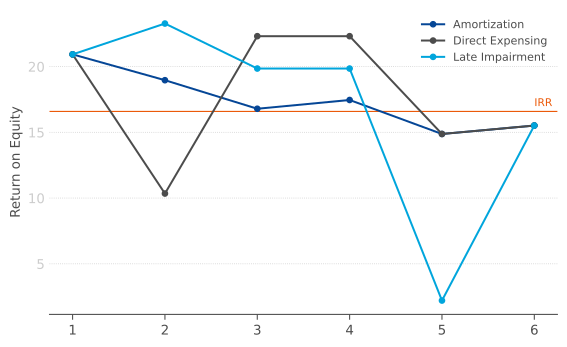
To summarize what was discussed, Figure 3.5 plots all \(ROE\) trajectories. It again shows that only the neutral case closely tracks the investment’s \(IRR\).
The examples are toy cases of accounting distortions that occur frequently. We assumed immediate dividend payouts to keep balance sheet gyrations in line. If we had not have done that, the pattern would be more complex. And everything becomes more complex once we add growth and changes in growth to the picture. But even with growth included, the basic message is the same. If we want an accounting system that provides as an accurate picture of periodic performance in terms of return on investment, then we want accounting to match expenses to revenues they bring about. As you are most likely aware, that is not always the case. For example, we do not capitalize and amortize many intangible assets. Why not? Because for many investments, it is very difficult to know ex ante, whether they yield future benefits (revenues). In the toy examples above, we acted like we knew in period 2 that the marketing campaign will generate additional revenues in periods 2-4 and to do so evenly, hence straight line. In reality, when the marketing campaign starts, we have at best only have a vague idea about its eventual success. This is big issue in contemporary accounting theory. On the one hand, some researchers argue not amortizing intangibles distorts key ratios and thus makes accounting less useful. On the other hand, some researchers argue the contrary. Direct expensing keeps speculation off the balance sheet, which leads to more reliable numbers and ratios.
One of the reasons for the difference in opinions is whether researchers look at earnings or return on investment metrics. To see why, imagine we continuously invest €100 each period from 1990 till 2010. Each investment has a useful life of 10 years and is used up evenly (after a year, the remaining value is €90, and so on). The investment is done at the beginning of the period and thus online for the full year it was made. This pattern of repeated investments with decreasing value is shown in the top plot of Figure 3.6.
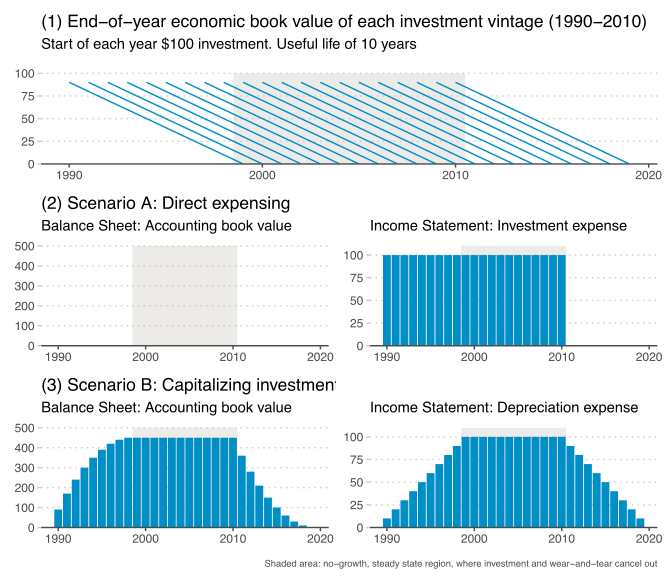
Figure 3.6 shows the impact of directly expensing the full investment amount each period (Scenario A), and the impact of capitalizing and straight-line depreciation (Scenario B). First, comparing the plots on the left shows that one unsurprising difference between both scenarios is that in one case there is no asset, a book value of zero, whereas in the other case there is a build-up in the asset position until a point (a steady state) is reached where the amount of investment expense (€100) equals the wear-and-tear of the already existing investments (10 times €10). Because investments equal wear-and-tear the asset base (the firm) does not grow anymore. This steady-state region is colored gray in the plot. Note that in the right plots the expense amounts in the steady-state region are exactly equal (depreciation expense equals investment expense). This is important because it shows that in steady state (no growth) there is no difference between direct expenses and capitalizing plus depreciating in terms of expense magnitude (and therefore in earnings magnitude) in the income statement. But there is a difference on the balance sheet. This means that \(ROE\) differs even though the economics are the same! In steady state, scenario A will show a relatively higher \(ROE = NI / CE\) because the numerator is the same as in Scenario B, but the denominator is smaller because the assets are not there.
This is why many companies with a large amount of successful R&D investments have high \(ROE\), because they miss the generated intangible asset on the balance sheet, which artificially distorts \(ROE\) upward. Pharma companies have this issue. You can try for yourself to see what happens to Netflix’s \(ROE\) if you capitalize the software costs for any reasonable guess of a useful life.
In fact, we encourage such pro-forma capitalization exercises, even if you decide to not do a pro-forma adjustment for your final model. This helps to get a feeling for the potential amount of distortion in \(ROE\). Koller et al. (2020), p. 237 also suggest thinking about capitalizing R&D, as these dramatically distort the profitability picture.8 A quick rule of thumb for such pro-forma capitalizations can be derived from the example in Figure 3.6. The asset on the books in steady-state is \(9/10+8/10+7/10+\dots+1/10\) times the investment value. If we generalize this, we arrive at the following rule of thumb assuming straight-line depreciation:
\[ BV = Inv \cdot \frac{\sum_{i=1}^{n-1}i}{n} \]
where \(BV\) is book value, \(Inv\) is investment expense, and \(n\) is the expected useful life of the asset. In the above example, this is \(100 \cdot 45 / 10 = 450\). However, this is only a rule of thumb that assumes a steady state. A proper pro-forma adjustment builds an amortization schema. If a firm is not in steady state, the investment expense is not equal the amortization expense and the book value also differs. In those cases, you need to swap the R&D expense on the income statement with an estimate of the amortization expense as derived from the schedule.
A final remark concerns the corner periods (1990-2000) and (2010-2020) in Figure 3.6. These are essentially growth and divestment periods. Build-up and release of hidden reserves interact with growth in investments, which makes the \(ROE\) dynamics even more complex. But, if you understood the basic mechanics at work in the steady-state example, you already know what to look for.
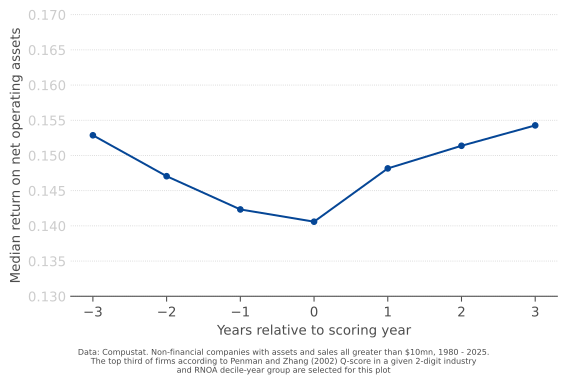
As a final illustration of the magnitude of accounting distortions and their importance, Figure 3.7 replicates some of the findings of Penman and Zhang (2002). The authors compute a Q-Score, which is a measure of hidden reserves due to conservatism. They define hidden reserves as the sum of capitalized R&D expenses (sum-of-the-digits, 5 years), capitalized advertising expenses (sum-of-the-digits, 2 years), and LIFO reserves, all scaled by net operating assets. The figure shows the median return-on-net-operating-assets for the top third of firms in a given year according to that score. The depressed \(RNOA\) is obvious, as is the mechanical increase to previous levels as hidden reserves reverse in later periods. Interestingly, Penman and Zhang (2002) find that investors are not always aware of such mechanical changes in profitability ratios, leading to a correlation of the QScore with abnormal returns.
There are other accounting distortions to look for. Is the economic risk of a business properly accounted for? For example, are allowances for doubtful receivables of sufficient magnitude? (If not, this is a type of aggressive accounting shown above). Are risky economic dependencies properly consolidated? Some of these issues we will see in our case studies in the practice sessions.
To summarize the key takeaways of this chapter, the first order of business is to understand the business. An important step towards assessing and predicting the core value drivers is a solid understanding of the firm’s business model and how it plans to create and sustain competitive advantages. The financials already help us here. Understanding accounting is key to understanding how a firm makes money and to reason about success and risk factors. Furthermore, beware of accounting measurement errors. A company might look worse or better than its peers when looking at simple ratios. But that can be an artifact of accounting measurement error. Before we can start to analyze a firm’s performance, we need to make sure we are aware of or even adjust for accounting artifacts that might obfuscate a firm’s economics, especially when it comes to its \(ROE\) and other profitability measures.
3.6 References
Strictly speaking increasing app users might also require more developing. A higher load or more server capacity needed might lead to additional features to be developed, but you get the point that the main task and costs are fixed.↩︎
From the notes to the consolidated statements of the 10-K: “Net sales include product and service sales. Product sales represent revenue from the sale of products and related shipping fees and digital media content where we record revenue gross. Service sales primarily represent third-party seller fees, which includes commissions and any related fulfillment and shipping fees, AWS sales, advertising services, Amazon Prime membership fees, and certain digital content subscriptions.” Analysts would certainly appreciate a breakdown of products, third party, AWS, and amazon prime.↩︎
We do so with a bit of dread. The question of what high quality accounting is has led to many heated debates and—to this day—is largely unresolved. Given that accounting numbers are used in many different functions, valuation analysis being only one of many, this is perhaps not too surprising. Just note that the view we present here is common, but also not the only one and not applicable in all situations. See Barker et al. (2020) for a general discussion on the objectives of reporting.↩︎
It is the discount rate that set the sum of the net present values of the cash-outflows and-inflows to zero. Meaning it is an annualized effective compounded return rate.↩︎
Note that this is less of an issue for an \(IRR\) that takes all periods into account.↩︎
This example inspired by the “Encom” case from Lundholm and Sloan (2019).↩︎
After reading all this one might wonder why most accounting regimes demand direct expensing of R&D. Is it not stupid to create such distortions? This is not the case. Accounting rules are the basis for many decisions, not only valuation decisions. For many of these, a more conservative approach is sensible, especially for investments that are highly uncertain to actually yield future benefits. We prefer a transparent but conservative accounting system that gives analysts enough information to make the choice of capitalizing uncertain investments themselves.↩︎