2 The Core Value Drivers
2.1 Purpose of this chapter
In this chapter, we introduce the core value drivers that focus and anchor an equity valuation analysis: return-on-equity (\(ROE\)), investment growth (\(g_i\)), and risk, or cost of equity capital, (\(r\)). We will spend some time deriving these. You find variations of these core drivers in many text books on the subject. The differences are mainly due to different points of focus. For example, the “McKinsey book” (Koller et al. 2020) uses return-on-invested-capital (\(RoIC\)) instead of \(ROE\), reflecting its focus on enterprise value instead of equity value. Likewise, they consider revenue growth as core value driver instead of investment growth, which reflects an output-focus instead of an input-focus. The main message and structure are the same.
2.2 How should we think about value?
Since we are most concerned about coming up with a dependable and defendable equity valuation, we should spend some time discussing what the main determinants of firm value are and how we can go about forecasting those.
The starting point for nearly any discussion is the so called Dividend Discount Model. It say that the value of an firm’s equity equals the present value of all dividends the firm will ever pay in the future. While this result is often presented as an assumption, it is in fact a derivation (For details on the hidden assumptions see Chapter 9)
\[ P_0 = \mathbb{E}_0\left[\sum_{t=1}^{\infty} \left(\frac{DIV_{t}}{\left(1 + r\right)^t}\right)\right] \tag{2.1}\]
- \(P_0\): market value of the common equity at time \(0\)
- \(DIV_t\): dividends at time \(t\)
- \(r\): discount rate, reflecting risk
- \(\mathbb{E}_0\): denotes uncertain, expected values
The Dividend Discount Model has been the basis for modern investment theory ever since the influential book by Williams (1938). It also makes intuitive sense: Just like any other investment, a firm should be worth the present value of the expected cash receipts it will provide to its owners (\(\mathbb{E}_0\left[\dots\right]\) stands for “expectations formed in period 0 about the term in square brackets”).
Unfortunately, it is not a good basis for illustrating the most important economic determinants of firm value. Dividends reflect the disbursement of funds, rather than the performance that created the ability to disburse funds in the first place. We can get a clearer picture of the economic forces determining value by examining the so-called residual income model. We can derive this model with one additional assumption, some rearranging, and the help of financial statement data.
2.3 The residual income model as a forecasting architecture
Recall that one of the main connections between the income statement and the balance sheet is earnings. As shown in Figure 2.1, the book value of equity represents the claim of the firm owners to the company’s assets. Earnings represent additional resources generated during the period between the two dates on which the balance sheet was recorded. Dividends reflect the outflows of funds to owners. In short, earnigns reflect ressrouce generation, dividends ressource distribution. It is arguably easier to forecast value generation than distribution. For example, when management decides to start paying dividends is largely up to management’s discretion. We would thus like a value model phrased in terms of value generation rather than distribution.
To get to that model, we will make use of some accounting equations. The change in owners’ claims to resources (the change in book value of equity) equals earnings minus dividends. The residual of earnings minus dividends is also often called reinvested earnings, since it is assumed that the additional resources generated are kept in the firm to fund investments.
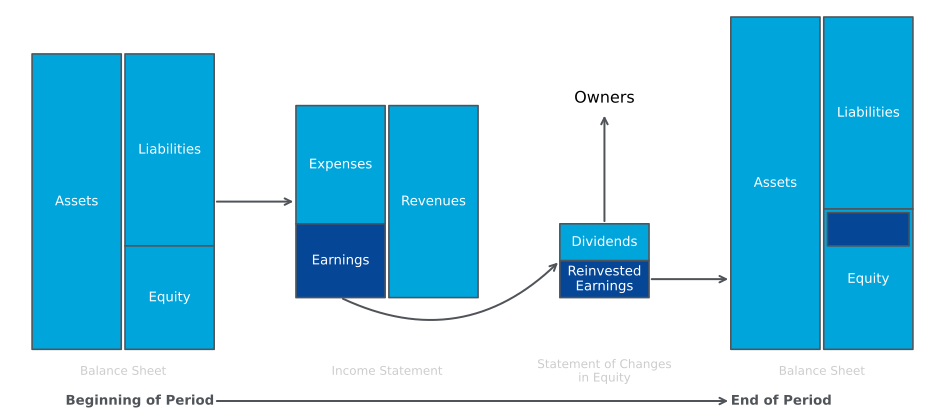
This intuition is encapsulated in the so-called clean surplus relation:1
\[ CE_{t} = CE_{t-1} + NI_t - DIV_t \]
where \(CE\) is common equity, \(NI\) is net income, and \(DIV\) is net dividends. The clean surplus relation implies that we can substitute \(DIV_t = NI_t - \triangle CE_t\). Doing so and rearranging leads to the residual income model (RIM) expression of firm value in Equation 2.2:
\[ P_0 = CE_0+ \mathbb{E}_0\left[\sum^\infty_{t=1}{\frac{NI_{t}-r \cdot CE_{t-1}}{(1+r)^t}} \right] \tag{2.2}\]
To get an even clearer picture of what determines firm value, the RIM can be further reformulated to express value as a function of return-on-equity, book value of common equity, and cost of equity capital:
\[ P_0 = CE_0+ \mathbb{E}_0\left[\sum^\infty_{t=1}{\frac{(ROE_{t}-r) \cdot CE_{t-1}}{(1+r)^t}} \right] \tag{2.3}\]
- \(P_0\): market value of the common equity at time \(0\)
- \(CE_t\): book value of the common equity at time \(t\)
- \(NI_t\): net income at time \(t\)
- \(ROE_{t}\): rate of return for equity owners in \(t\)
- \(r\): discount rate, reflecting risk
- \(\mathbb{E}_0\): denotes uncertain, expected values
Equation 2.3 is fundamental. (We put the full derivation for those that are interesteted into Chapter 10). Assuming that the accounting does a decent job reflecting the fundamentals of the firm, Equation 2.3 says: “Firm value above and beyond the book value of equity is determined by how much a firm’s return-on-equity exceeds its cost of equity times the amount of invested equity capital.” Stated differently, a firm only creates value in a given period if the return on equity exceeds an expected return (\(ROE - r\)). The amount of value created depends on this excess return multiplied by the amount of invested equity capital and discounted for risk \(r\).
This is why we like to express value—at least for the purposes of building a model—using the RIM rather than cash flow-based models. (\(ROE - r\)) is something that is easier for us to reason about in terms of fundamentals than levels of cash flows or dividends. That is not to say the RIM gives you a different answer. If you make the same assumptions, both RIM and cash flow-based models give you the same valuation. Assuming the clean surplus relation holds, they are mathematically equivalent. The beauty of the RIM lies in that it expresses a firm’s value generation in an economically intuitive way and thus provides a couple of safe guards against modeling mistakes:
- You see directly in which periods value is generated (profitability above a hurdle rate). Value generated per period is usually easier to reason about than about cash flows.
- There are economically obvious anchoring points, especially for long-term dynamics.
To exemplify point 1, consider the following forecast of a company: “$1bn in free cash flow today growing at an average rate of 30% over the next ten years”. Can you immediately judge the forecast’s plausibility? Probably not. What about the following statement: “35% ROE over the next 20 years” The second statement should immediately make you suspicious. Considering an average \(r\) to be somewhere between 8%–12%, this is close to three times the cost of equity, even for high \(r\). Only exceptionally profitable firms with insurmountable barriers to entry can dream of earning such an excess return. Big markets with the potential for such profitability and the opportunity to build such barriers are very rare.2 For the first statement ($1bn with a 10-year average growth rate of 30%) you would need to find comparables, as there is no good way to judge the magnitude and growth economically. You would find that only three companies managed to pull off such a high and growing free cash flow number: Apple, Amazon, Google.
An example of point 2 is that, in the long run, a company without sustainable competitive advantages should earn just its cost of capital. This implies that, as \(t \rightarrow \infty\), the \(ROE\) should approach \(r\). Any valuation model where such a convergence is not happening is assuming that the firm can fend off competition forever, an unrealistic assumption for most firms.
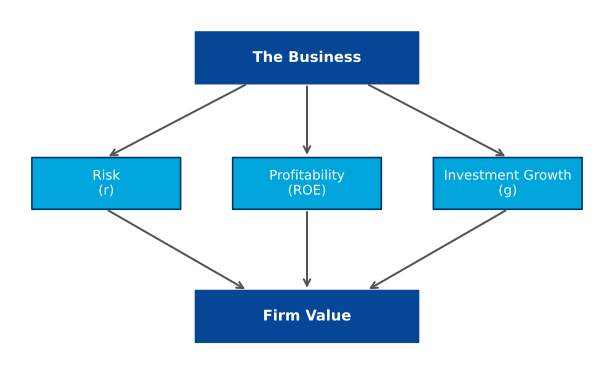
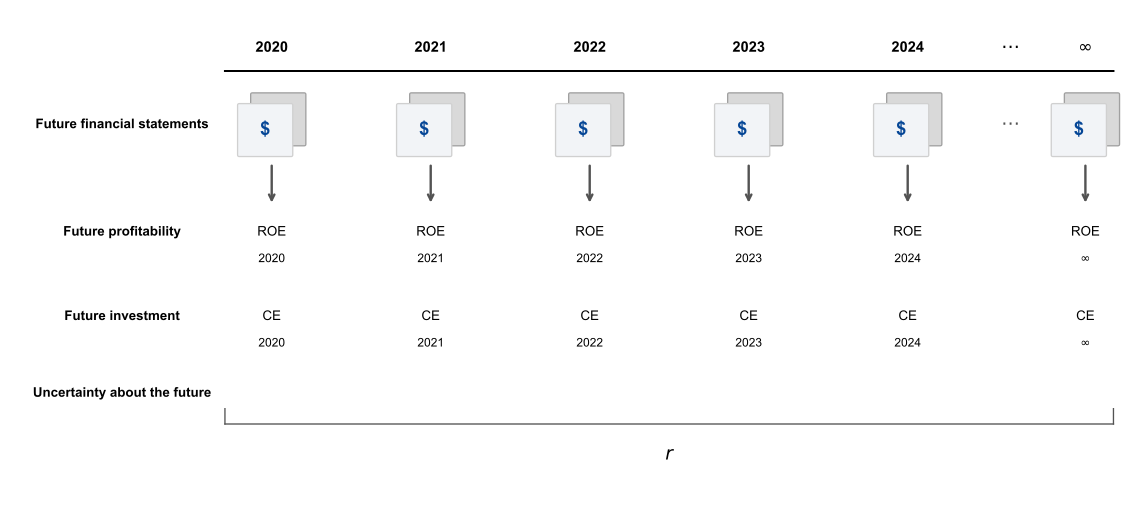
In summary, we like to express value using the RIM because it provides us with more opportunities to sanity-check our valuation and modeling. It also nicely illustrates the core value drivers, as summarized in Figure 2.2. We will discuss each driver in turn.
2.4 Profitability
For the reasons discussed above, return-on-equity (\(ROE\)) will be our anchor measure of profitability. It is—if the accounting is done right—our measure of periodic return on investment (\(ROI\)) from the perspective of equity holders.
\[ RoI = \frac{\text{Earnings for the period}}{\text{Investment at the beginning of the period}} \]
Only if \(ROE > r\) does a firm create value in \(t\). This is key because it implies that growth itself does not create value! Growing earnings (or cash flows) when the rate of return equals the expected rate of return (\(r\)) means just that: no value is created—the firm just achieved the minimum to not destroy value. That is why \(ROE\) is, for the purposes of financial modeling, the standard anchor on which we focus.
Due to competitive forces, maintaining a high \(ROE\) is rare. It can only happen if some forms of barriers to competition prevent other firms from competing away the profitability of the business. Of course, this presupposes that the \(ROE\) we are looking at is reflecting the business and the economics well. For example, pharmaceutical companies often have high \(ROE\). But, that \(ROE\) is inflated by accounting for intangibles understating the book value of equity for these firms. This is something we always need to check during an analysis and a significant part of the next chapter (Chapter 3) is devoted only to that purpose.
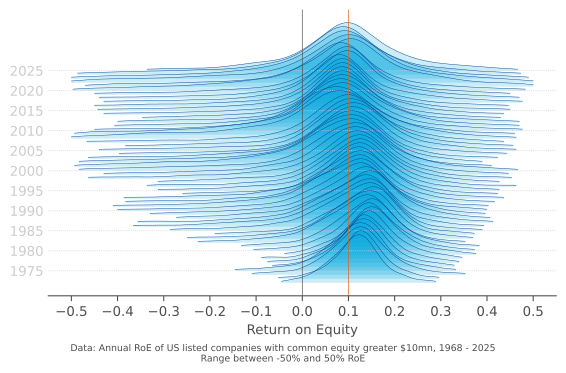
Figure 2.3 shows that the distribution of return-on-equity, at least in the observable sample of US listed firms, has changed substantially over the years. Especially notable is the increasing number of loss-making firms. This evolution has many reasons. Business models have changed over time, competition likely increased, and US-GAAP has changed significantly (e.g., large impairments are more frequent). In addition, the type of firm that lists itself on the US stock market has changed since the implementation of the Sarbanes-Oxley Act of 2002.
Notwithstanding these changes, we can also see that the mass of the distribution is roughly concentrated around 8%–12%. Depending on the risk-free rate and market premium of a period, this is the range, where we would expect the average cost of equity (\(r\)) to be. Thus, this range is where we would expect to find the \(ROE\) of average companies (those just earning around their cost of capital). We highlight these distributions to reiterate the point that \(ROE\) is strongly governed by competitive economic forces and that long-term deviations from \(r\) are rare.
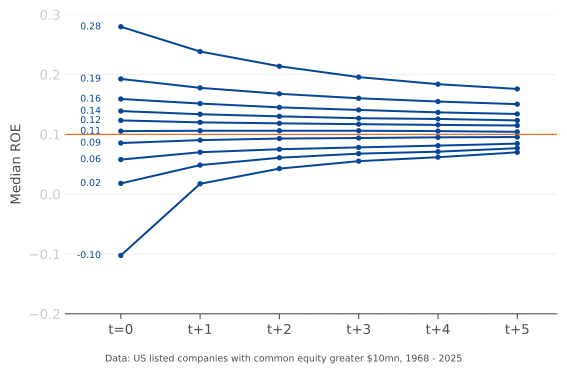
We can see the same competitive dynamics when observing how firms’ \(ROE\) evolve over time. Figure 2.4 shows how the median return-on-equity for ten portfolios (deciles) of firms reverts over time. The portfolios were constructed as follows. Each year, all firms are ranked into deciles based on their \(ROE\). The 10% firms with the highest \(ROE\) go into the top decile and so on. Then we simply track the median ROE for these firms over the next five years.
As can be seen, there is strong mean reversion even after one year already. Competition eroding excess profitability for top performers and competition pressuring bottom performers to be fixed or abandoned is likely one of the main explanations.3
2.5 Investment/growth
If 20% \(ROE\) on an investment of 100 euros sounds good, then 20% \(ROE\) on 1,000,000 euros surely sounds better. If we have a profitable investment, scaling it without sacrificing profitability in the long run is the key. This is obvious from Equation 2.3. The numerator of the yearly discounted residual income term is: \((ROE_{t}-r) \cdot CE_{t-1}\). So, conditional on high excess profitability, increasing the amount of invested equity \(CE\) is going to increase value. This means that growth (in invested capital) and profitability interact, something we will dedicate a separate discussion in Section 2.7 to.
However, simply growing the amount of invested capital in a profitable endeavor is not a simple way to guarantee more value creation. The additional investment must be deployed at the same \(ROE\) to achieve the desired effect. This largely depends on the opportunities to deploy said capital. The size of the firm’s markets (in terms of revenue potential) and the maturity of the market (see Figure 2.5) provide a natural boundary. This is why some textbooks (e.g., Koller et al. 2020) consider revenue growth instead of invested capital growth as the core value driver. We fully agree that revenue potential of the market is a key driver of investment growth that we will pay special attention to.
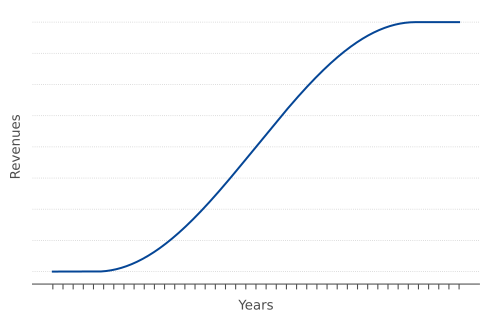
Another way to see this is to reformulate the residual income model a bit. Starting from Equation 2.3 and assuming a constant \(ROE_t\), we can simplify the abnormal profitability part to: \(ROE_t-r = ROE - r := \Bar{m}\). Think of \(\Bar{m}\) as the long run abnormal return. Then:
\[ \begin{aligned} P_0 & = CE_0+ \mathbb{E}_0\left[\sum^\infty_{t=1}{\frac{(ROE_{t}-r) \cdot CE_{t-1}}{(1+r)^t}}\right]\\ & = CE_0+ \mathbb{E}_0\left[\sum^\infty_{t=1}{\frac{CE_{t-1}}{(1+r)^t}} \cdot \Bar{m}\right] \end{aligned} \tag{2.4}\]
Equation 2.4 says that firm value equals book value plus the NPV the long run abnormal return on investment times invested common equity. With some further assumptions, we can simplify this further to arrive at an expression of firm value as a function of market size and abnormal returns. Remember the clean surplus relation \(CE_t = CE_{t-1} + NI_t - DIV_t\). Assuming a constant \(ROE\) and a constant dividend payout ratio \(d\), this simplifies to \(CE_t = CE_{t-1} \cdot (1 + ROE - d)\). When would a firm pay out less then it earns (\(ROE - d > 0\))? When it wants to grow its investment base. When does it want to do that? Firms need a certain level of investment in assets to generate sales. You need factories to produce goods, etc. So if we want to manufacture more goods, we need more factory capacity and thus more investments. Assume a constant “investment efficiency” \(\gamma\) in the sense of: \(\gamma := CE / S\) where \(S\) is sales (revenues). \(\gamma\) measures how much in sales we can generate with the amount of investment in equity we have.4 This means we can say:
\[ CE_t = CE_{t-1} \cdot (1 + ROE - d) = S_t \cdot \gamma = S_0 \cdot \gamma \cdot (1 + g_s)^t \]
The right-hand part of the last equation just assumes that a firm balances the dividend payout ratio (note that \(d\) can be negative if we think of issuing new equity as a negative dividend) to accommodate sales growth \(g_s\), then:
\[ \begin{aligned} P_0 & = CE_0+ \mathbb{E}_0\left[\sum^\infty_{t=1}{\frac{CE_{t-1}}{(1+r)^t}}\Bar{m}\right]\\ & = CE_0+ CE_0 \cdot \mathbb{E}_0\left[\sum^\infty_{t=1}{\frac{(1+g_{CE})^{t-1}}{(1+r)^t}}\cdot \Bar{m}\right]\\ & = S_0 \cdot \gamma \left( 1 + \mathbb{E}_0\left[\sum^\infty_{t=1}{\frac{(1+g_{s})^{t-1}}{(1+r)^t}}\cdot \Bar{m}\right]\right)\\ & = S_0 \cdot \gamma \left( 1 + \mathbb{E}_0\left[\Bar{g_s}\cdot \Bar{m}\right]\right) \end{aligned} \tag{2.5}\]
Equation 2.5 says: firm value depends on the initial “market size and share” (measured in revenues in period 0, \(S_0\)) times how much investment we need to generate those sales (\(\gamma\) times one) plus the expected future growth in sales \(\Bar{g_s}\) (market growth times market share) times abnormal profitability \(\Bar{m}\).5
Another (maybe simpler) way is to start with Equation 2.2 and again expand \(CE_0 = CE_0 * \frac{S_0}{S_0}\) and \(CE_{t-1} = CE_{t-1} * \frac{S_t}{S_t}\)
\[ \begin{aligned} P_0 &= CE_0+ \mathbb{E}_0\left[\sum^\infty_{t=1}{\frac{NI_{t}-r \cdot CE_{t-1}}{(1+r)^t}} \right]\\ &= S_0 \cdot \frac{CE_0}{S_0} + \mathbb{E}_0\left[\sum^\infty_{t=1}{\frac{\left(NI_{t}-r \cdot CE_{t-1}\right)\cdot \frac{S_t}{S_t}}{(1+r)^t}} \right]\\ &= S_0 \cdot \frac{CE_0}{S_0} + \mathbb{E}_0\left[\sum^\infty_{t=1}{\frac{\left(\frac{NI_t}{S_t}-r \cdot \frac{CE_{t-1}}{S_t}\right)\cdot S_t}{(1+r)^t}} \right]\\ &= S_0 \cdot CapInt_0 + \mathbb{E}_0\left[\sum^\infty_{t=1}{\frac{\left(NetMargin_t-r \cdot CapInt_t\right)\cdot S_t}{(1+r)^t}} \right]\\ \end{aligned} \tag{2.6}\]
Equation 2.6 has the same message: firm value depends on the initial “market size and share” (measured in revenues in period 0, \(S_0\)) times how much investment we need to generate those sales (\(CapInt\)) plus the expected future growth in sales \(S_t\) versus \(S_0\) (market growth times market share) times an abnormal net margin \(NetMargin_t-r \cdot CapInt_t\). You can think of \(r \cdot CapInt_t\) as a minimum expected amount of profits per dollar of sales. For example, if we need 50 cents of equity per dollar of sales and we expect 10% return of every dollar of equity invested, then we would expect 5 cents of return for every dollar of sales generated.
What you should take away from Equation 2.5 and Equation 2.6 is that growth in investment (target sales = market size times market share, multiplied with the capital needed to generate those sales) is the root value driver. It is very much driven by the market size you expect the firm to be able to service. That is why in most discussions, forecasts about revenue potential and revenue growth take center stage. We will return to this point frequently in later chapters.
In a McKinsey study, Baghai et al. (2007) argue that there are three categories of revenue growth: portfolio momentum (the organic growth of the market itself), market share performance (whether the firm gains or loses market share), and M&A. They argue that for large firms, the largest driver of growth in the past was portfolio momentum: whether firms are in fast-growing, potentially large markets.
Note that revenues are price times volume. So, there are markets with high volume and low prices (low profitability), which is why we are a bit hesitant to call revenue growth a core driver, even though it is one of the most important metrics to consider.
There are also other considerations when it comes to investment growth. Servicing all corners of the market could also increase costs to the extent that it lowers overall \(ROE\). Thus, growing beyond a certain size in a given market might not be appealing. Finally, financing costs, whether equity or debt costs, must be taken into account. These dictate the \(ROE > r\) condition for attractive investments. Finally, investment is generally sensitive to uncertainty. If a firm has leeway in timing investments and investments are partially irreversible, there is value in delaying investments to wait for information to arrive and make a more informed investment decision at a later time (Dixit and Pindyck 1994).

For these and other reasons, one typically observes a significant variation in investment rates over time. Figure 2.6 shows excess investment flows (approximated as R&D + Capex - Depreciation and Amortization) by sector and geography. Markets become saturated, technological developments make existing products (markets) unattractive, etc.
Again, while investment growth is a core driver of value, its optimal level depends on the revenue potential and the interaction with the other two drivers, \(ROE\) and \(r\). Structurally, market attractiveness and profitability might differ by geography, etc. This will be a common theme in the following chapters: While it is helpful to think of \(ROE\), \(g_{CE}\), and \(r\) as distinct and separate drivers, they are not independent!
2.6 Risk
Risk, as reflected by the cost of equity-capital, is the most elusive of the three core value drivers. It is the main way we account for the uncertainty in our assessment of future performance. Mathematically, \(r\) is the discount rate in the calculation of the net present value. One can think of it as opportunity cost: What return on investment would the average investment with the same risk characteristics earn? But what are these risk characteristics and why do they matter?

Figure 2.7 shows that equity returns are more volatile than the return on the 10-year treasury yield, which is an investment considered nearly risk-free. So, is risk just the chance of large, unforeseeable variation in future performance?
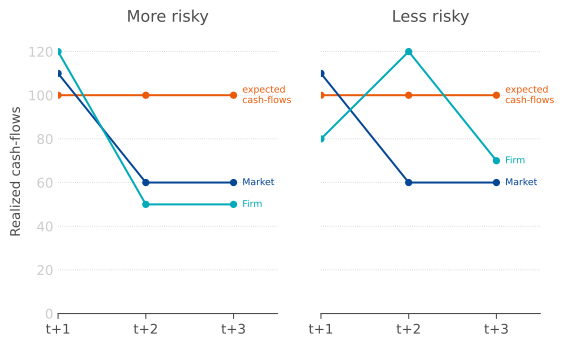
The answer is no; it also matters whether the variation is systematically related to certain factors. Figure 2.8 tries to provide some intuition. Consider the shares of a firm (firm A) and some measure of ‘the market’ (e.g., the performance of the S&P 500 or the MSCI World Index ETF). Figure 2.8 shows three simulated scenarios. The left panel shows the scenario where firm A is strongly positively correlated with the market, the midel panel shows the scenario with no correlation, and the right panel shows the very rare scenario of a very acyclical firm (strong negative correlation). Both price series are normalized to 1 on trading day 1.
All three panels further show you what would happen if you would build a portfolio that contains firm A shares and market ETF shares in equal proportions. You see that in the left panel, it does not really matter whether you hold firm A, the market, or the portfolio. You would get very similar performance. This is due to the strong correlation and one simplifying assumption we made in the simulation. Both the firm and the market have the same average daily return (0.04%) and standard deviation (1.5%). In the middle panel, the portfolio’s performance is much less volatile (the sample standard deviation goes from 1.53 to 1.09). This is even more pronounced in the right panel. Because the firm is acyclical its performance partially counters the ups and downs of the market, leading to a much smoother line, trending around the common mean daily return of 0.04%.
As an investor, you actually really only care about the performance of the portfolio – not about the performance of individual assets. The riskiness of individual assets (and the price you are willing to pay for taking on this risk) should thus depend on how including it would change the uncertainty of the expected performance of your portfolio.6
In modern asset pricing we assume that there are some risk factors that assets are exposed to (correlated with). Intuitively the definition of risk as used in modern asset pricing can be understood as: cash flows that are more uncertain and that are more likely to not materialize when you need income are riskier.7 In standard asset pricing models (with deep markets and a large number of firms), such ‘systematic risk’ is the only risk that investors receive a ‘price discount’ for holding it. If the uncertainty is ‘idiosyncratic’ (not correlated with your future need for income) and you want to pay a lower price for the stock, you will not get your wish. Another, better-diversified investor will offer a higher price for the stock. Since she is more diversified, the idiosyncratic risk is less relevant to her. Thus, she will offer a higher price, and you have to match or not get the stock.
Modern asset pricing theory still struggles to some extent to really pinpoint what the indicators are for situations in which we need more income. In the above example, we assumed that when the market is down, you have a greater need for cash and therefore investments that do not provide this cash are riskier. In principle, risk factors can be understood in this way. However, these links are not always obvious. Coming up with the right discount rate \(r\) is still one of the most difficult and unresolved issues in finance. We will discuss this issue in more detail in Chapter 7.
An important reminder is also in order here. As illustrated in Figure 2.2, all three drivers are dependent on the firm’s business model and thus interdependent. For example, an investment that has the potential for outsized profitability is usually also riskier. A very common mistake is to forget about this interdependence, choose one \(r\) (maybe based on industry) at the beginning and then model the “numerator” without ever checking whether the assumptions about future investments, markets, and profitability should not also lead to a rethinking of the riskiness of the business—and thus the discount rate \(r\).
2.7 Profitability and growth interact
An important insight from Equation 2.2 is that profitability and growth interact. We are talking about this term \((ROE_{t}-r) \cdot CE_{t-1}\). We can see the growth aspect more clearly by slightly rearranging the formula to:
\[ \begin{aligned} P_0 & = CE_0+ \mathbb{E}_0\left[\sum^\infty_{t=1}\frac{(ROE_{t}-r) \cdot CE_{t-1}}{(1+r)^t} \right] \\[1em] & = CE_0 \cdot \left(1 + \mathbb{E}_0\left[\sum^\infty_{t=1}{\frac{\overbrace{(ROE_{t}-r)}^{\text{profitability}} \cdot \overbrace{\frac{CE_{t-1}}{CE_0}}^{\text{growth}}}{(1+r)^t}} \right] \right) \end{aligned} \tag{2.7}\]
with \(\frac{CE_{t-1}}{CE_0} = \prod_{\tau}^{t-1}(1+g_\tau)\) representing cumulative growth.
- \(P_0\): market value of the common equity at time \(0\)
- \(CE_t\): book value of the common equity at time \(t\)
- \(ROE_{t}\): rate of return for equity owners in \(t\)
- \(r\): discount rate, reflecting risk
- \(\mathbb{E}_0\): denotes uncertain, expected values
Equation 2.7 shows that growth and excess returns are substitutes to some extent. A fast-growing firm with low excess returns can be as valuable as a slowly growing firm with high excess returns. In practice, growth often has a bigger effect on valuation (but it is a bit difficult to draw general conclusions here, as \(r\) obviously also plays a role and is not independent of growth, and \(ROE\)).

Figure 2.9 is a replication of the famous result by Skinner and Sloan (2002) that nicely highlights the importance of this interaction. It follows mechanically from Equation 2.7 that if there are high growth expectations in a stock, earnings surprises (changes in expected profitability) should have a greater effect on stock prices. Figure 2.9 shows exactly that.8
2.8 A common analysis structure via financials
The preceding discussion should have highlighted that a sensible structure for an analysis aimed at valuing a firm focuses on forecasting the three core value drivers: profitability, investment growth, and risk. It also highlighted that these drivers are not independent. We will thus need a certain support to make sure our forecasts of all three are sensible.
As shown in Figure 2.10 this support will be provided by pro-forma financial statements. By forcing ourselves to prepare pro-forma financial statements, we reason about the different aspects of each driver and ensure that they fit together. If we forecast growing sales, what asset base do we need to support these sales? How is this asset base financed? How much of this is fixed versus variable costs and what are the implications for profitability? And so on.
Pro-forma statements are incredibly useful and provide a crucial opportunity to sanity-check our assumptions. For example, does equity become negative after a few years, even when forecasting a 10% net margin? This happened in student cases more than once. The issue usually boiled down to students forecasting a very profitable business model in the sense of high margin and low required invested capital and failing to realize that their forecasts implicitly assumed that all excess cash is used for share repurchases (using equity as a plug, more on that in the forecasting chapter). This is usually a hint that some assumptions are too good to be true and should be rechecked.
The point of the preceding example is that such sanity checks require pro-forma financial statements and a solid understanding of accounting basics. The goal of the next chapter is thus to provide you with the tool-set to analyze and understand a firm’s business via the lens of its financial statements.
2.9 References
Strictly speaking, the clean surplus relation is often not fulfilled. There are transactions in many reporting systems that change the book value of equity and do not pass through the income statement. Examples in IFRS are certain currency effects or certain items related to pension liabilities. This can be easily remedied by defining earnings to be equal to comprehensive income rather than net income. However, the effects are often minor and can be ignored. Share repurchases and issuance also change the amount of book value and are not earnings. In most text books, these are just treated as “dividends” in the sense of additional funds provided by or disbursed to owners.↩︎
An alternative is that the ROE number is distorted upwards by accounting artifacts. An issue we will cover in Chapter 3.↩︎
There are some other forces affecting this pattern too. They mainly concern sample issues, i.e., firms non-randomly dropping out over the 5 years after portfolio formation due to M&A and similar activities.↩︎
I am glossing over some details here that we handle in detail in Chapter 4. We usually think of “net operating asset turnover” as our measure of efficiency. But those assets need to be financed. Which is what the balance sheet equation expresses. If assets go up, ceteris paribus equity has to go up.↩︎
The preceding reformulation of the RIM was inspired by a similar simplification I found in Helmer and Hastings (2016).↩︎
You might be tempted to look at the middle panel and say: “I’d rather own 100% of the market than the portfolio”. But this would be hindsight bias. Your investement is in day 1 without knowing how the next 250 trading days (roughly a year) will play out. Thus, you’ll likely want some type of diversification.↩︎
This is our attempt to explain in simple terms the idea behind consumption based-asset pricing theory.↩︎
There are other interesting things going on here too between value and growth firms and interested readers are encouraged to read the original study (Skinner and Sloan 2002).↩︎