8 Capita Selecta
8.1 Purpose of this chapter
In this chapter, we collect important details and advanced topics we believe are important to cover.
8.2 Wealth transfers in stock transactions
If a company is able to issue or repurchase its own shares at a price that differs from the intrinsic value implied by its existing business opportunities, the intrinsic value of the company will change due to a transfer of wealth between the original stockholders and the transacting stockholders. In a very real sense, this is similar to buying/selling something with an over/undervalued currency.
| Company Repurchases Stock from Existing Stockholders | Company Sells Stock to New Stockholders | |
|---|---|---|
| Transaction price \(>\) intrinsic price | From ongoing to selling stockholders | From buying to ongoing stockholders |
| Transaction price \(<\) intrinsic price | From selling to ongoing stockholders | From ongoing to buying stockholders |
As Table 8.1 shows, if an overvalued company issues overvalued stock and you buy it, you are basically paying too much money for what you get. In contrast, those who already own shares of the company get more money from you than the value of the share they give to you.
This issue often occurs in M&A and stock repurchase situations. It is best explained via an example, which is what we do in the last case of the course.
8.3 Scenario Analyses
Valuation and financial modelling is so difficult not only because it is a complex topic, but a significant part of the complexity occurs because we have to deal with many highly uncertain aspects. Forecasts rest on assumptions about complicated economic dynamics that can change quickly and in unpredictable ways. We often see students and young professionals making overconfident valuation calls because they do not appreciate the large uncertainty in their model assumptions. Conversely, we also see many students and young professionals make overly cautious valuation calls because they are acutely aware of the high amount of uncertainty in their work.
Scenario analysis, if done well, is immensely useful to provide more confidence in your work. It is also important for decision makers to know what the biggest threats are to the valuation estimate. But it is very hard to incorporate more than a few sources of uncertainty into a scenario analysis. Simulations, on the other hand, can incorporate many sources of uncertainty and we found them to be a nice tool for visualizing how fast uncertainty can accumulate. Here is a simple example.
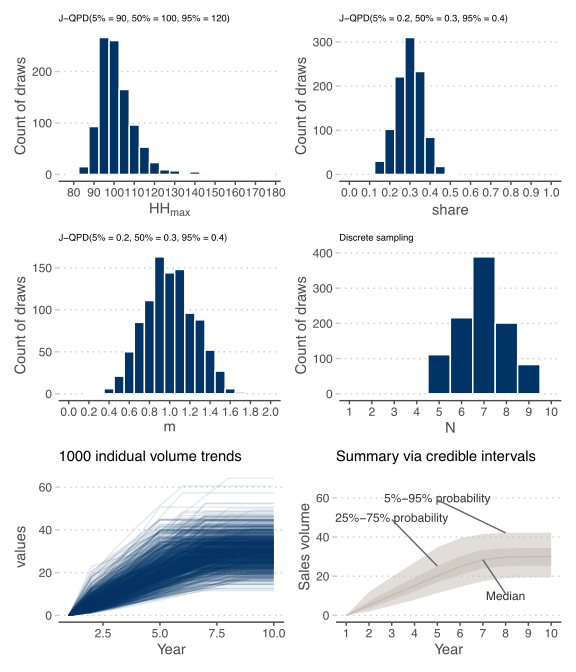
Assume that we want to estimate the yearly volume for a product. We do this by modelling market size and market share. We model the size of the market per year based on the eventual maximum number of households that have demand for the product, \(HHmax\), and the saturation at which this maximum market size is reached, \(sat\_grade_t\). Market share is denoted as \(share_t\).
\[ vol_t = HHmax \cdot sat\_grade_t \cdot share \]
We further want to model the saturation rate \(sat\_grade_t\) as a function of the number of years, \(N\), it takes to fully saturate the market, and a rate parameter \(m\) that dictates the shape of the rate of progress. Of course, this is not a full, or even a good, model. For a proper model, we would break this down further. For example, \(share\) should obviously be \(share_t\). Depending on the business, \(share_t\) would be a function of our assessment of the firm’s marketing prowess, product characteristics versus competing products, competitors’ actions, etc. And market saturation will obviously depend on these actions as well. But even in this simple setup, there are already four things we are uncertain about.
- The maximum number of HH that represent the ceiling for this market, \(HHmax\)
- The amount of years it takes the market players to saturate the market \(N\)
- Whether most of the saturation happens early on, or later (Rate parameter \(m\))
- The market share of the product \(share\)
After doing our research on these four inputs, we have formed beliefs about possible values. We can use simulation techniques to express those beliefs in a sort of “multiple universes” way. Say we want to simulate 1.000 universes, which is just another way of saying we want to have 1.000 draws from different random number generators. Let us start with \(HHmax\). Assume that after researching the market for a while we expect that the maximum addressable market will be about 100 million HHs. But we are unsure. It could be more or less. Say, we believe that there is only a small chance (1 in 20) that the maximum market size is lower than 90 million and only a 1/20 chance that it is higher than 120 million. We can express this belief through a J-QPD distribution (Hadlock and Bickel 2017). It takes as input three quantiles/percentiles (which we sort of given you above) and draws a distribution around those constraints. Once we have a J-QPD random number generator (which is, for example, in the R rjqpd package) and calibrated it according to our beliefs, we can draw 1.000 times from it. We can do this with the other uncertain inputs to our model as well. We get the following distributions and the resulting distribution of revenues.
What we like about this type of simulation is the following:
- It is so easy to visualize how fast uncertainty propagates and also exactly what form it takes. And we really want to know our forecast uncertainty before making any serious decisions (in our humble opinion). We have not found a better way to communicate this uncertainty as precisely and transparently as is done here.
- It is very flexible. We can do our normal modelling. And just add one dimension. Instead of putting in a value for an input assumption, we put in x amount of samples drawn from a sampling distribution, effectively quantifying your subjective beliefs.
- It is a good guide for highlighting where more research is needed to reduce uncertainty. And conversely, where we simply cannot get a more precise forecast given the resources we have.
- We found that the J-QPD is quite helpful for teaching. It is often difficult to spell out our beliefs in detail. But one can often say “well at the median I would expect this value and I would be highly surprised (e.g., chance 1/20 or 1/100) if it is lower than x and higher than y”.